
Wharton Esherick spent the first thirty-odd years of his life trying to be a painter, and he was not a very successful one.
Then he started carving the frames.
The frames turned out to be better than the paintings. He kept going, further into three dimensions, out past the frame and into the object, and by the end he had a name that gets used two ways: father of American studio furniture, and dean of American craftsmen.
One. He was not looking for wood. Wood found him.
He was born in Philadelphia in July 1887. He studied at the Philadelphia Museum and School of Industrial Art, then painting at the Pennsylvania Academy of the Fine Arts from 1908, and he left in 1910 without a degree.
The turn came in the winter of 1919. His wife Letty had been to a lecture by the progressive educator Marietta Johnson, and the family went down to Fairhope, Alabama, to spend time at her school. In the school's manual training workshop there were tools he could borrow, and Esherick, a painter with time on his hands, picked up a gouge.
That is the whole origin. No apprenticeship, no family trade, no plan. A borrowed chisel in someone else's workshop while his wife pursued an interest of her own.
He was thirty-two. Consider that alongside Krenov starting at thirty-seven and Maloof at thirty-three, and a pattern in this series becomes hard to ignore: almost nobody in the front rank of American furniture set out to do it.
Two. He built the building.
The part of Esherick that still stops people is not a chair. It is the studio.
He began it in 1926 on Valley Forge Mountain outside Paoli, and he did not stop. He worked on that building for over forty years, adding to it, carving into it, treating the structure itself as the piece. Door handles, light switches, the stair, the desk, the walls: all of it made, none of it bought.
The cantilevered spiral staircase he added in 1930 is the object people come to see. Each tread is a solid piece of ax-hewn red oak, mortised into an upright log that twists up through the middle. It is genuinely structural, genuinely engineered, and it looks like something that grew.
In 1940 the architect George Howe put that stair and Esherick's furniture into the Pennsylvania Hill House at the New York World's Fair. That is how most of America first saw it.
The studio opened as a museum in 1972, two years after he died, and was made a National Historic Landmark in 1993. Almost everything in it is still where he left it.
Three. He got paid in acting lessons.
This is the detail worth carrying.
Esherick had a long relationship with the Hedgerow Theatre in Rose Valley. He designed sets. He designed costumes and lighting. He cut woodblocks and printed their posters. And he made furniture for the building.
He was not paid for a good deal of it, at least not in money. He bartered the furniture against acting lessons for his daughters.
Sit with that for a second. One of the most significant American makers of the twentieth century traded his work for something his children wanted, from people he liked, in a place he cared about. The furniture went into a working theatre and stayed there for decades, getting used.
There is a version of a career that runs through galleries and price lists. There is another that runs through the people immediately around you, and Esherick's ran through both. The theatre pieces were eventually auctioned in 2020, which tells you what the barter turned out to be worth.
What to carry forward
Carve the frame. When the main thing is not working, look at what is around it. Esherick's entire career came out of paying attention to the part he thought was secondary.
Make the room, not just the object. He treated a door handle and a staircase with the same seriousness as a cabinet, and the result is that the building reads as one thing. Very few makers ever get to build the room. All of us decide whether the thing we make fits one.
Barter is not a lesser transaction. He traded furniture for his daughters' education and nobody involved felt short-changed. Money is one way to price work. It is not the only honest one.
Straight lines are optional. He came from painting and sculpture, so he never absorbed the rule that furniture must be square. Nothing enforces that rule except habit.
A note on sources
Dates, the Fairhope trip and the 1919 turn follow the Wharton Esherick Museum and his Wikipedia entry. The 1930 spiral stair, the 1940 Pennsylvania Hill House at the New York World's Fair, and the Hedgerow barter are documented by the museum and by contemporary Philadelphia press coverage of the 2020 Hedgerow auction. The studio on Valley Forge Mountain is open to visitors, which remains the only real way to understand what he did.
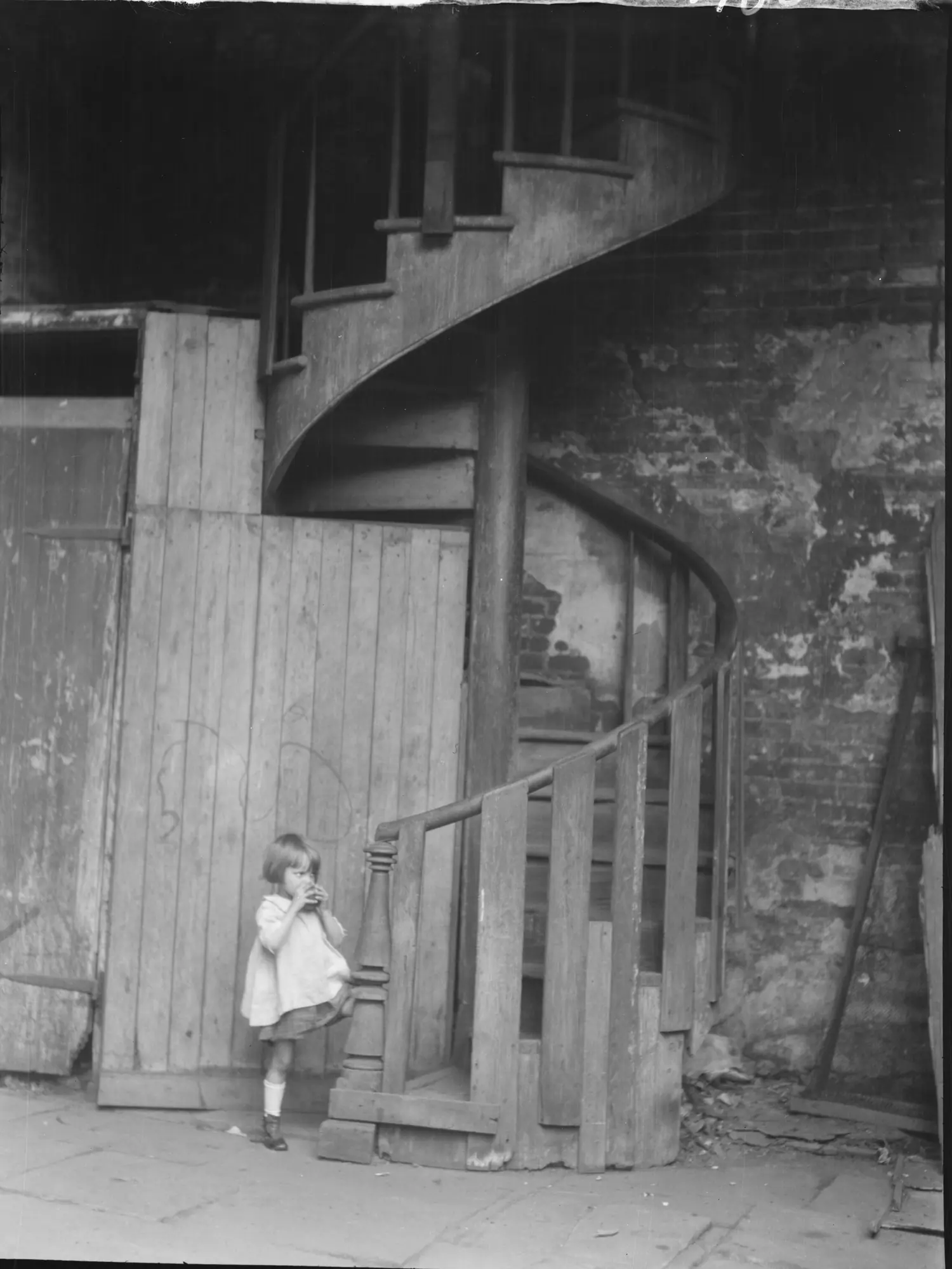
We have not reproduced any of his work here. The estate is museum-held and those images are not ours to use. The staircase above belongs to a courtyard in New Orleans.