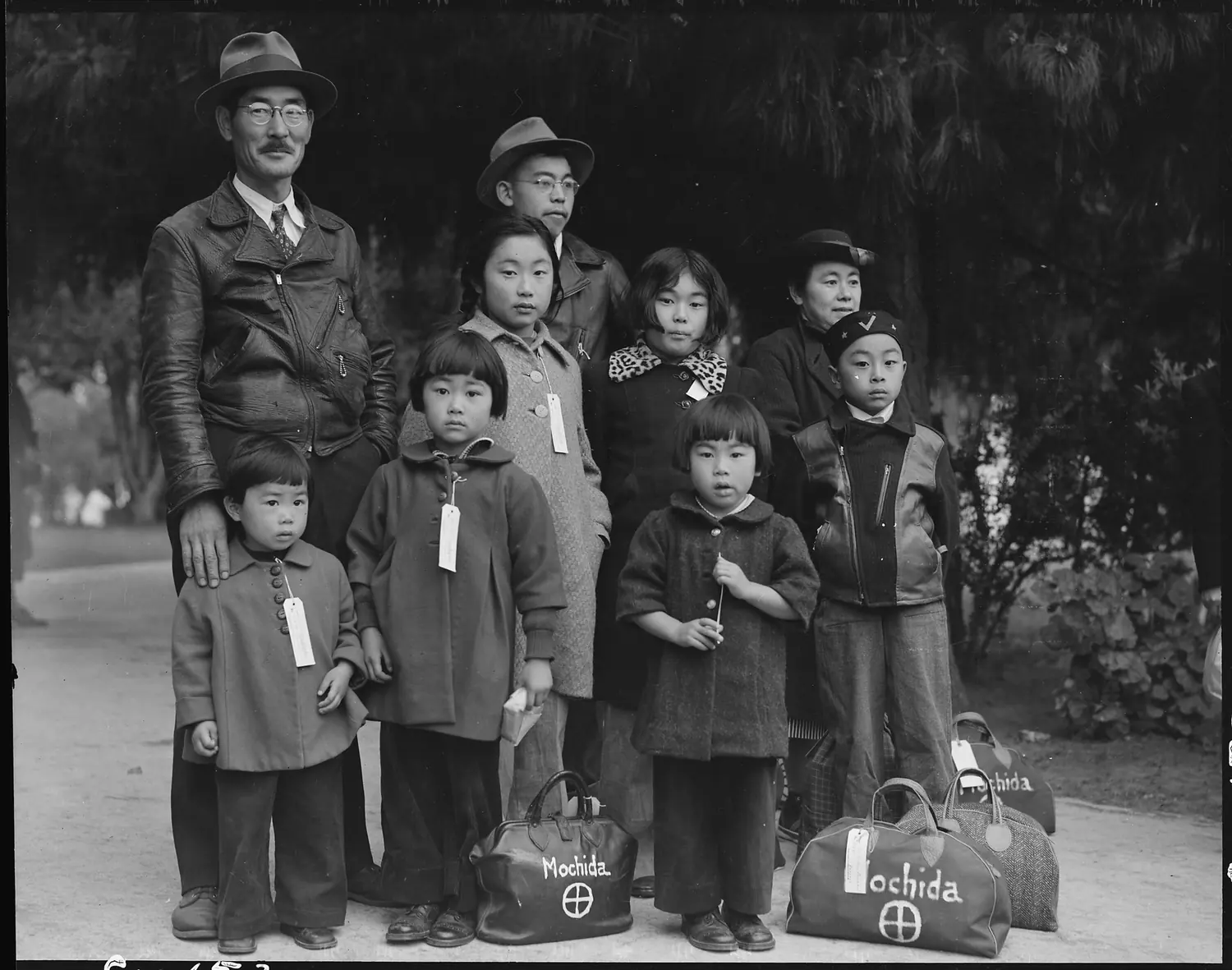
In 1942 the United States issued 120,000 of its own citizens and residents with a paper tag on a string. You wore it, your children wore it, your luggage wore it. The tag carried a number, so that families could be kept together while they were moved to the camps.
Sixty-six years later a furniture maker whose own family had worn those tags decided to make all 120,000 again.
One. The lineage runs straight through this series.
Wendy Maruyama was born in 1952 in La Junta, Colorado, third-generation Japanese American. She was born deaf in both ears and has worn a hearing aid since she was nine.
She took a BA at San Diego State in 1975. From 1976 to 1978 she was at Boston University's Program in Artistry, studying under Alphonse Mattia and Jere Osgood. Then an MFA at the Rochester Institute of Technology's School for American Crafts in 1980.
Read those two names again. Mattia and Osgood were both Tage Frid's students, from the previous episode. The Danish apprentice system that America imported in 1948 reached her in a Boston classroom thirty years later, through the people Frid trained.
At RIT she was one of the first women, and the first deaf student, to complete that furniture MFA. It is worth being precise about what that means. The barrier was never that the work requires hearing. The barrier was that a field had quietly decided who belonged in it, and was wrong on both counts at once.
From 1989 to 2014 she ran woodworking and furniture design at San Diego State, twenty-five years of it.
Two. The Tag Project.
Executive Order 9066 was signed by Franklin Roosevelt in February 1942. It led to about 120,000 people of Japanese descent, most of them American citizens, being removed from their homes and held in ten camps. Maruyama's maternal relatives were among them.
In 2008, during a residency at SUNY Purchase, she began researching it properly. What came out was a body of work, and at its centre The Tag Project: a replica of every single identification tag. All 120,000, made by hand, with hundreds of volunteers across the country writing them out.
They are bundled by camp and hung in great heavy clusters, so you stand underneath them.
Think about why that works, because the reasoning transfers to anything you make.
The number 120,000 is unusable. It is too large to picture and the mind files it as "a lot" and moves on. That is what statistics do to atrocity. But 120,000 physical objects, each one written by a hand, each carrying a real name, cannot be rounded off. You are not told the scale. You are standing under it.
And the labour is the point. Making them by hand, and having many people make them, means the work contains an enormous quantity of ordinary human attention. That is the memorial. The tags are not a representation of the effort. They are the effort.
Set this beside episode two. Nakashima came out of Minidoka having learned Japanese joinery from a carpenter interned alongside him, and spent the rest of his life making beautiful things without ever making the camp his subject. Maruyama, two generations later, made the camp the subject and used the craft to do the counting.
Two entirely legitimate answers to the same history: one makes beauty in spite of it, the other makes an accounting of it. The series is better for containing both.
Three. She did not stay in furniture.
Her wildLIFE Project is six elephant heads, life-sized, built from segments of painted wood, standing up to twelve feet. It is about poaching and the ivory trade.
There is a sharpness in a woodworker taking that on. Ivory was for centuries a material this craft used freely, for inlay, keys and handles, and the trade in it is precisely what the work indicts.
She was inducted into the American Craft Council's College of Fellows in 2009 and received its Gold Medal for Consummate Craftsmanship in 2024.
What to carry forward
Scale is an argument. If a thing matters and people are not feeling it, the answer may not be a better explanation. It may be making enough of it that it cannot be waved away.
Let the work be about something. Most furniture is about proportion and material, which is honourable and sufficient. But the craft is entirely capable of carrying an idea, and almost nobody asks it to.
Bring other people's hands in. She could not have made 120,000 tags alone, and if she had, it would have meant less. Shared labour is a legitimate part of a piece, not a compromise of it.
Check what your trade assumes. Furniture had decided, without ever examining it, what kind of person makes furniture. Whatever your own version of that is, it is probably a habit rather than a fact.
A note on sources
Dates, education, the Boston University years under Mattia and Osgood, the 1980 RIT MFA, the San Diego State years and the awards follow her Wikipedia entry. The Smithsonian Archives of American Art holds an oral history interview with her from March 2010, which is the best first-hand account. The Tag Project and the wider Executive Order 9066 body of work are documented by the Museum of Craft and Design, the Morikami Museum and the Institute of Contemporary Art San José. Her own site is wendymaruyama.com.
One detail repeated in some places about her health is not supported by the stronger sources, so we have left it out rather than pass it on.
She is alive and working, so nothing of hers is reproduced here. The photograph above is Dorothea Lange's, made for the government that ordered the removal, and it shows the Mochida family of Hayward, California, on 8 May 1942.