
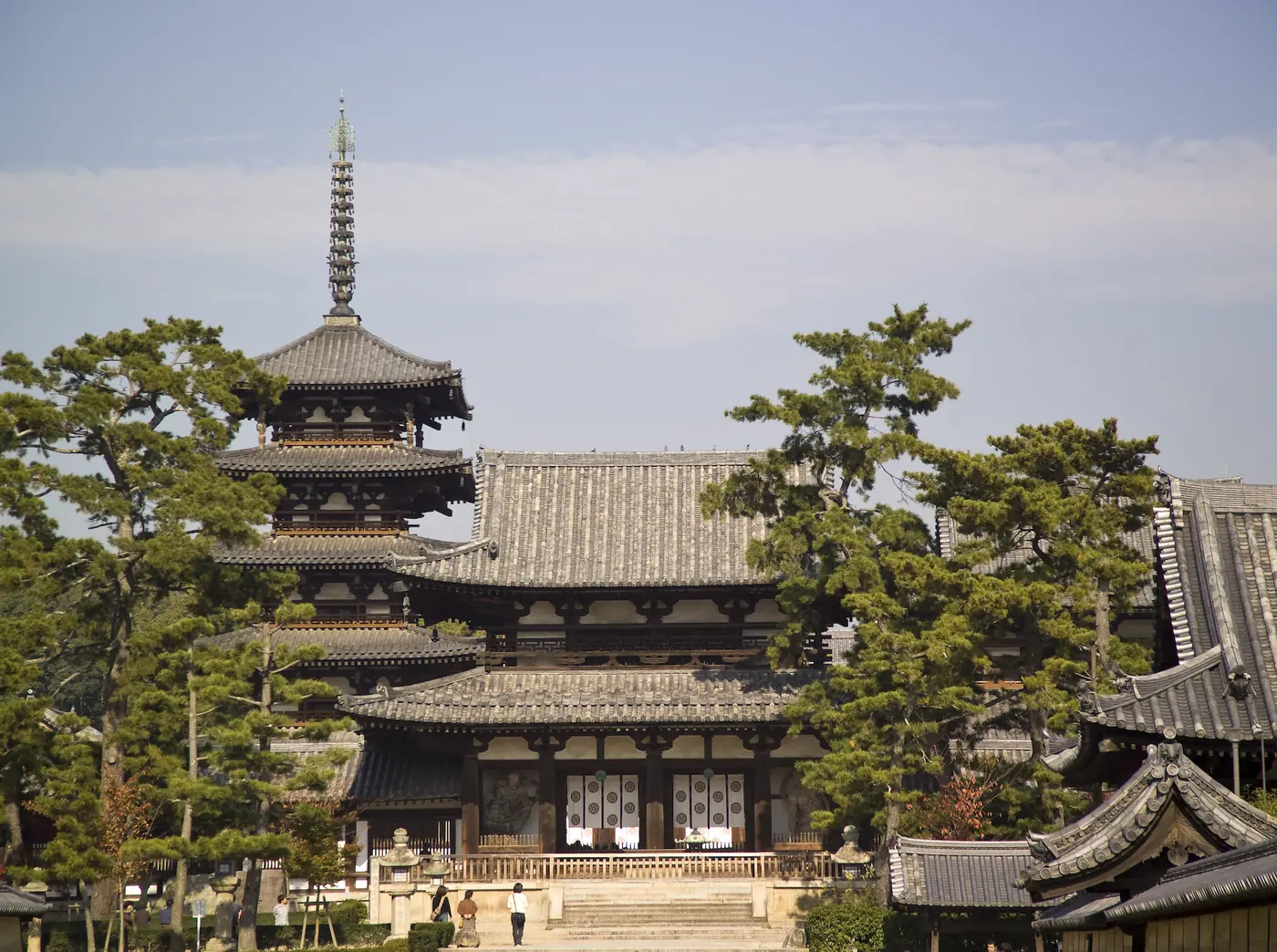
There is a temple in Nara called Horyu-ji. Parts of it have been standing since the seventh century, which makes them the oldest wooden buildings on earth. They have survived thirteen centuries of earthquakes, typhoons and rot, and they were put together without nails.
Tsunekazu Nishioka spent his life keeping them up.
One. Three generations on one building.
He was born in September 1908. His grandfather Tsunekichi and his father Naramitsu were both master carpenters of Horyu-ji before him. He was raised inside the work, and he led the major Showa-era repairs to the temple, then the reconstruction at Yakushi-ji, both now UNESCO World Heritage sites.
A miyadaiku is a temple and shrine carpenter, and it is a separate discipline from ordinary carpentry, with its own training, tools and body of knowledge. Nishioka is usually called the last of them, which is not quite fair to the people still practising, but does capture something true about a line thinning almost to nothing in his lifetime.
He was famously severe. Apprentices called him oni, the demon, for the way he corrected them.
Two. A thousand-year tree for a thousand-year building.
His central teaching is one sentence: a thousand years of life exists in a thousand-year-old tree.
He meant it as an instruction. If a building is expected to stand for a millennium, the timber in it has to have already stood for a millennium. Fast-grown wood carries fast-grown behaviour, and it will not hold that long no matter how well you cut it.
The second part is stranger and more specific. Nishioka held that a timber should be placed in the building according to how it grew on the mountain. A tree that grew on a north-facing slope, taking the cold wind on one side, goes into the north face of the building. Wood from the south side goes south.
It sounds mystical and it is not. A tree grows unevenly in response to wind, light and slope, and that asymmetry stays in the timber as differences in density and in how it will move. Match the timber to the exposure it already knows and it behaves predictably for centuries. That is close observation over many generations, written down as a rule.
He also said wood surpasses iron. Anyone who has seen a nail rust out of a board while the board is still sound knows exactly what he meant, and it is the reason Horyu-ji is still there.
Three. What a thirteen-hundred-year deadline does to your decisions.
This is where he is most useful to the rest of us, and it has nothing to do with temples.
Almost every decision a maker makes is made against an unstated timescale. Which glue, which finish, which joint, whether to allow for movement. Assume five years and one set of answers is obviously right. Assume a thousand and most of those answers become absurd.
Nishioka worked to the longest timescale anybody has ever used, and it drove every choice: the species, the age of the tree, the orientation of each piece, the joinery, the refusal of metal fasteners.
You are not building a pagoda. But the question generalises. How long is this thing supposed to last, and have I actually made decisions consistent with that answer, or have I just used what was on the shelf?
He died in April 1995, aged eighty-six.
What to carry forward
Ask how long it has to last, out loud, before you start. Then check that your glue, fixings and joinery agree with the answer.
Wood outlives metal, in the places metal touches it. Every fastener is a future failure point in a piece that would otherwise keep going.
Orientation is information. You may not be matching timbers to mountainsides, but which face goes out, which way the grain runs, and which side saw the sun are real variables and most of us assign them at random.
Slow-grown material behaves differently. Tight rings are not an aesthetic preference. They are a different material with different manners.
A note on sources
Dates, the family line of Horyu-ji carpenters, the Showa repairs, the Yakushi-ji reconstruction and the oni nickname follow his Wikipedia entry and the Japan Woodcraft Association's record of him. His sayings about the thousand-year tree and about wood surpassing iron are quoted in the 2012 documentary An Artisan's Legacy and in The Building of Horyu-ji, the book drawn from his teaching.
The photograph above is of Horyu-ji itself, which is public domain.