
Two episodes ago we said that Thomas Chippendale is a book rather than a workshop. Thomas Sheraton is the harder version of the same sentence, because with Sheraton there may not have been a workshop at all.
No piece of furniture anywhere can be documented to his hands. There is no evidence he ran a cabinetmaking business of any size in London. And there is a style named after him that filled drawing rooms on two continents.
One. He taught drawing, not joinery.
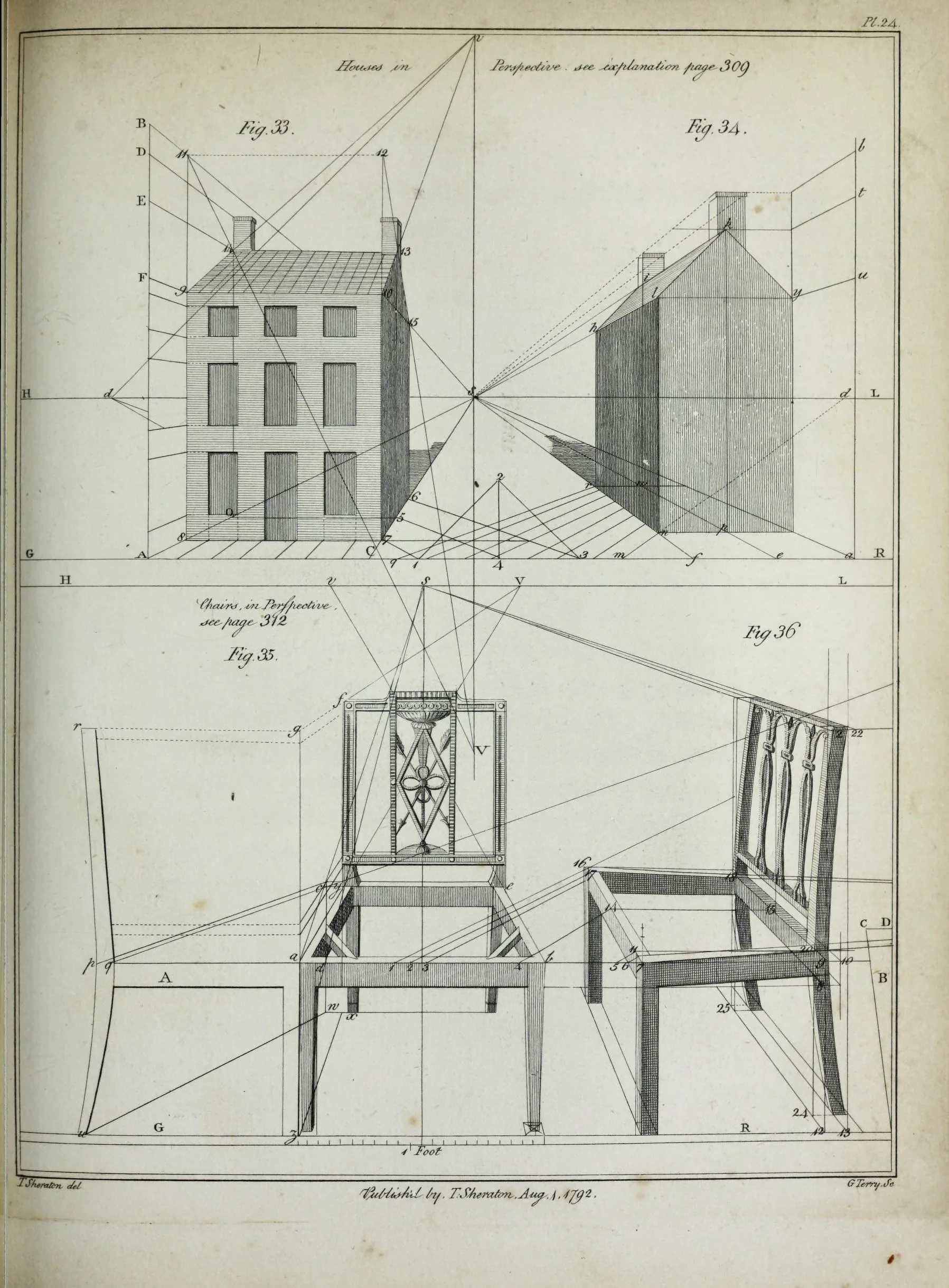
Look at the plate above, and notice what it is.
It is not a design for a chair. It is a chair drawn in perspective, with the construction lines left in: the horizon, the vanishing point, the projection of every leg and rail. Above it, houses drawn the same way. The whole sheet is a lesson in how to put a solid object on paper correctly.
That is what The Cabinet-Maker and Upholsterer's Drawing-Book, issued in parts between 1791 and 1794, actually is. A large part of it is geometry and perspective. The furniture designs come after, and they come after because you are expected to have learned to draw first.
Chippendale published a catalogue. Sheraton published a course.
He was born in Stockton-on-Tees in 1751 and trained as a journeyman cabinetmaker, so he knew the trade from the bench. He came to London around 1790, and from that point on he made his living from books, from teaching drawing, and from writing and preaching as a Baptist.
Around six hundred people subscribed to the Drawing-Book, and most of them were cabinetmakers and upholsterers. His audience was the trade. He was not selling taste to gentlemen, he was selling skill to makers.
Two. It killed him poor.
He kept publishing. The Cabinet Dictionary came out in 1803. He began an encyclopaedia of the trade in 1804 and had not finished it when he died in 1806.
He died in poverty. A young man named Adam Black, who later founded a publishing house, worked for him briefly and left a description of the household that is genuinely grim: the family living in one squalid room, the man himself full of talent and unable to convert any of it into a living.
This is the part of the story worth sitting with, because it is the direct rebuttal to the lesson two episodes ago. Publishing made Chippendale's name and it made Sheraton's name too. Only one of them ate.
Documentation multiplies reach. It does not, by itself, produce income. Those are two different problems and a maker who confuses them will end up famous and hungry.
Three. What the style actually is.
Sheraton furniture, as the term is used, means straight lines rather than curves. Square tapered legs, often reeded. Rectangular chair backs instead of the shield. Light in section, restrained in ornament, inlay rather than carving.
It is a genuine departure from Chippendale's rococo and it is more disciplined than Hepplewhite's. Whether Sheraton invented it is another question: he was recording and systematising what fashionable London was already moving toward, which is a large part of why the book was useful.
The name stuck because the book was the clearest statement of it, and because he wrote a title page.
What to carry forward
Learn to draw the thing. Not to make it pretty, to make it true. Perspective with the construction lines still visible is a way of thinking, and it catches errors before the timber does.
Teach the trade, not the taste. His readers were makers. Two hundred years later the most durable furniture content is still the kind that shows another maker how, rather than showing a customer what.
Reach and income are separate problems. Solve both or accept the consequences. This is not a historical curiosity, it is the exact failure mode available to every maker with an audience and no order book.
A style label is a bibliography. Sheraton, Hepplewhite, Chippendale: these are three books. Knowing that changes how you read every antique description you will ever see.
A note on sources
His birth at Stockton-on-Tees in 1751, his training in the cabinetmaking trade, his move to London around 1790, the publication of The Cabinet-Maker and Upholsterer's Drawing-Book in parts between 1791 and 1794 with roughly six hundred subscribers, The Cabinet Dictionary of 1803, the unfinished encyclopaedia, and his death in poverty in 1806 are documented by the Victoria and Albert Museum and by the standard furniture-history scholarship.
Adam Black's account of visiting the household is well known and is the source of the picture of Sheraton's poverty. It is one man's recollection written down later, so we have described it rather than quoted it as fact about every year of his life.
That no furniture can be firmly attributed to him, and that there is no good evidence of a substantial workshop, is the settled position among furniture historians rather than a provocation on our part.
He died in 1806, so the plate above is long out of copyright.