
Thomas Chippendale is the most famous furniture maker in the English language. Almost nothing survives that can be proved to have come out of his workshop by his own hands.
Both of those statements are true, and the gap between them is the lesson.
One. He published.
He was baptised in Otley, in Yorkshire, in 1718, the son of a joiner. He went to London, and by 1754 he had premises in St Martin's Lane.
That same year he brought out The Gentleman and Cabinet-Maker's Director: a large folio of engraved designs, sold by subscription, running to a hundred and sixty plates. A second edition followed in 1755 and a third, much enlarged, in 1762.
Pattern books existed before him. Nothing existed on that scale, by a working cabinetmaker, covering chairs, beds, bookcases, china cabinets, mirror frames, candle stands and everything else a household might order, drawn to be worked from.
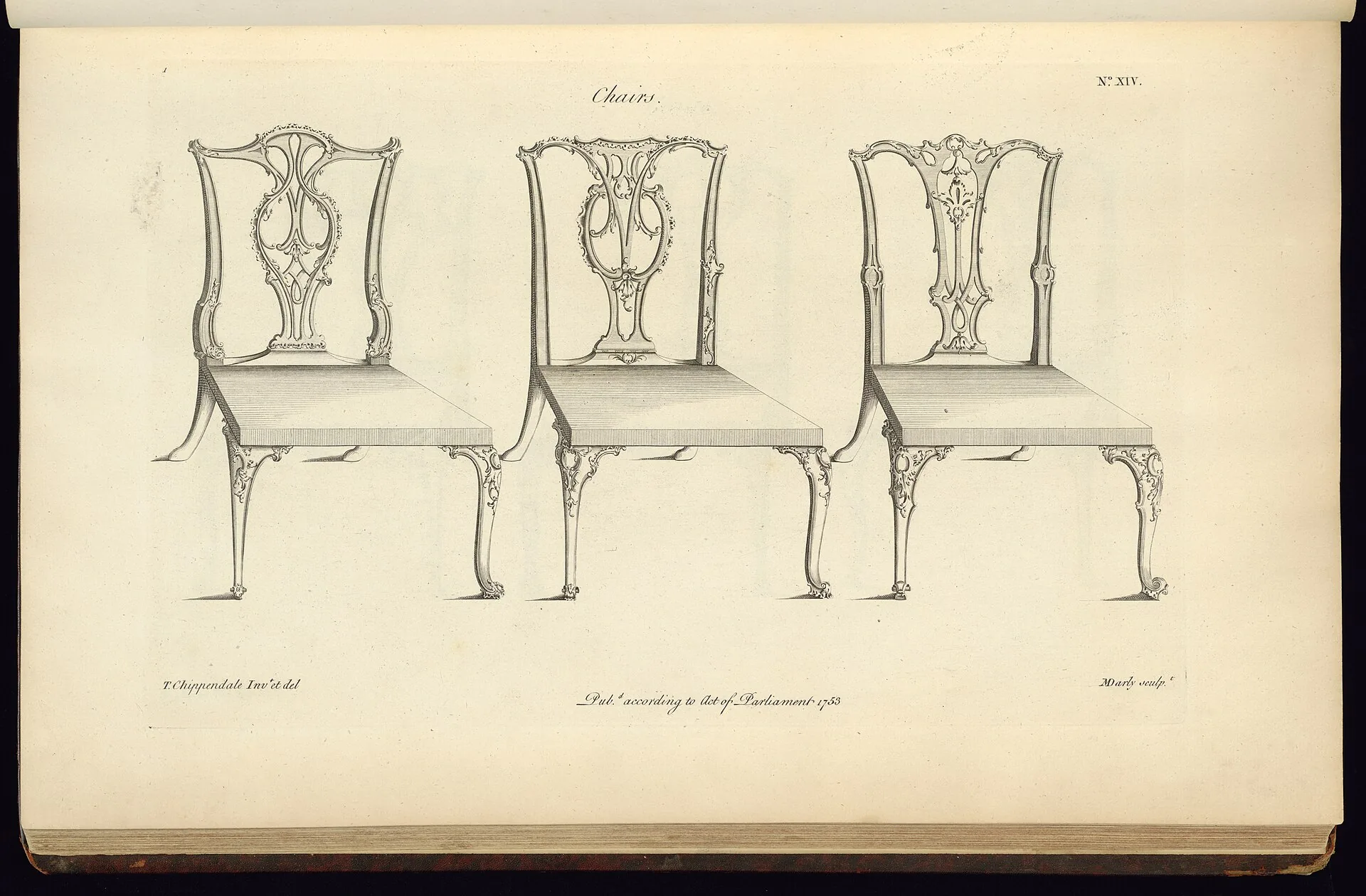
The plate above is one of them. Three chairs, rococo backs, cabriole legs, the differences between them small and deliberate. The imprint at the foot reads that it was published according to Act of Parliament, which is a copyright notice: the 1735 Engraving Copyright Act protected printed designs. Chippendale invented the ideas, drew them, and had Matthias Darly cut the plate.
Two. What the book actually did.
A cabinetmaker in Philadelphia or Dublin or Newcastle who never met Chippendale could buy the Director, open it on the bench, and build from it. Thousands did.
So the style went everywhere. And because the book carried his name on the title page, everything built in that manner picked up his name too, whoever made it. Chippendale is not a workshop. It is a book that got out.
This is the only reason we say Chippendale and not the name of some equally capable London maker who kept his drawings in a drawer. Craft skill was not the differentiator in 1754 London. There were hundreds of men who could cut that carving. What Chippendale did that they did not was write it down and sell it.
There is an uncomfortable modern echo here that is worth naming plainly. The maker who documents the work reaches a hundred times more people than the maker who only does the work. That has been true for two hundred and seventy years. It was true before photography, before the internet, and before any of the reasons we normally give for it.
Three. He was not a rich man.
The picture of Chippendale as a grand figure is wrong. He ran a business that was frequently short of cash. His partner James Rannie died in 1766 and the finances never fully recovered. He worked to Robert Adam's designs on interiors at houses like Harewood and Nostell Priory, and the reason we can attribute those pieces at all is that the bills and account books survive in the houses.
That is how his work is authenticated: paperwork, not style. A chair that looks like a Director plate proves nothing, because the whole point of the Director was that anybody could build from it.
He died in 1779, of tuberculosis, and was buried at St Martin-in-the-Fields. His son, also Thomas, carried on the business.
Set him beside the last episode. The Shakers at Mount Lebanon also printed a catalogue, also numbered their models, also sold to strangers who would never see the workshop. A London cabinetmaker chasing aristocratic commissions and a celibate religious community in New England arrived at the same conclusion within a century of each other: the thing that carries a workshop past its own walls is a printed document.
What to carry forward
Document the work, not just the piece. Drawings, dimensions, the reasoning. It is the single highest-return thing a small workshop can do and it has been true since 1754.
Show variations, not one answer. That plate is three chairs that are nearly the same. It lets a client choose and it lets a maker adapt. One perfect drawing sells nothing.
Fame follows the record, not the skill. There were better carvers than Chippendale in London. There was nobody better at making the work legible to people who were not in the room.
Keep the paperwork. Everything we can actually prove he made is proved by an invoice. Your account books are your provenance.
A note on sources
His baptism at Otley in 1718 as the son of a joiner, the St Martin's Lane premises, the first edition of The Gentleman and Cabinet-Maker's Director in 1754 with its second edition of 1755 and enlarged third edition of 1762, the partnership with James Rannie and Rannie's death in 1766, the documented work at Harewood House and Nostell Priory alongside Robert Adam, and his death in 1779 are documented by the Victoria and Albert Museum, by the Chippendale Society, and by the surviving house archives.
The plate above is held by the Cooper Hewitt, Smithsonian Design Museum, catalogued as a page from the Director engraved by Matthias Darly. The imprint at the foot of the sheet is dated 1753, a year before the first edition was published, which is normal for plates cut and registered ahead of a book going out.
He died in 1779, so his work and his book are long out of copyright. That is why this episode can show the real thing.