
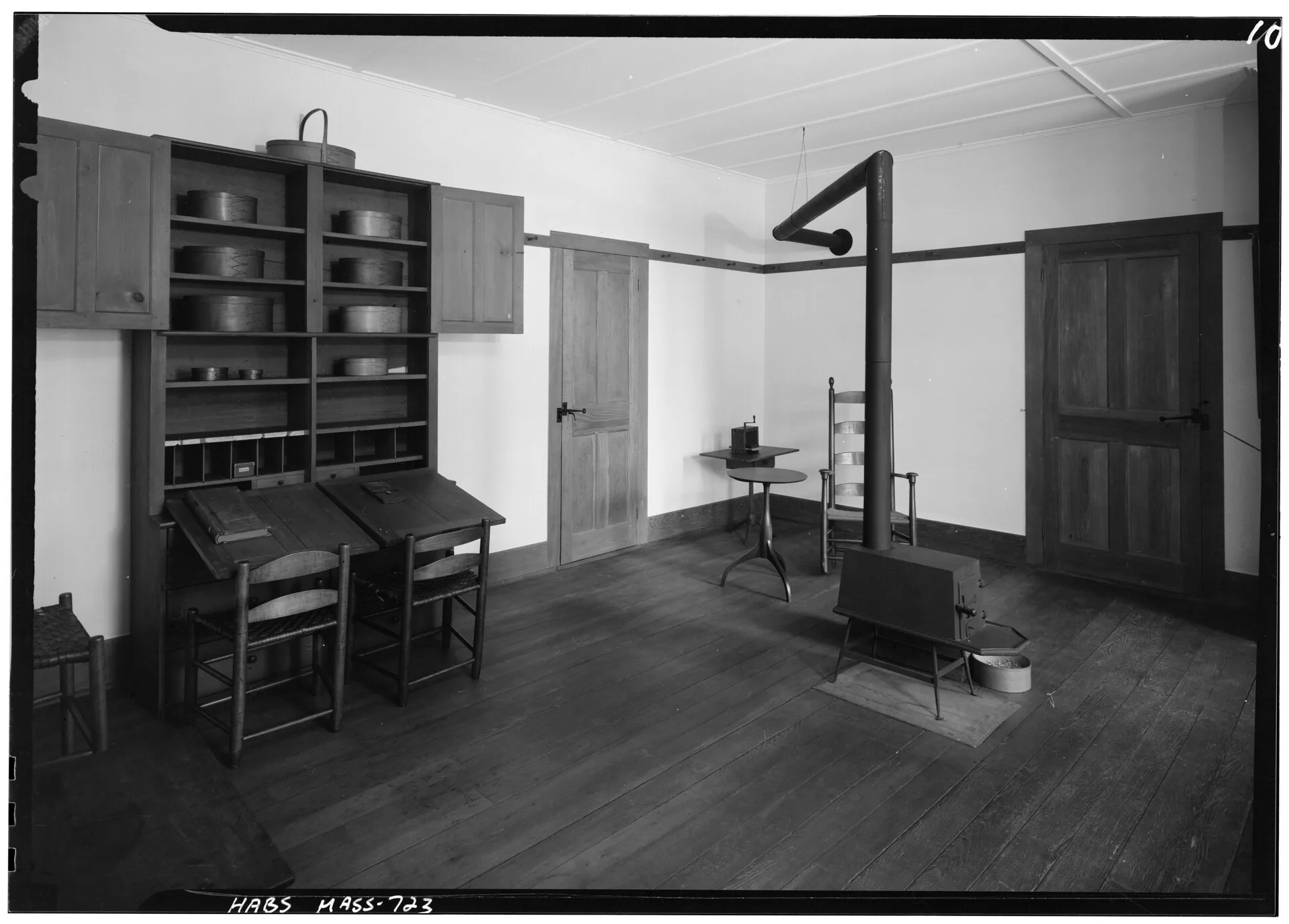
Look at the photograph above before you read anything else.
That room was photographed in 1962 at Hancock, in Massachusetts, but the furniture and the joinery in it are from the first half of the nineteenth century. Built-in cupboards with drawers below, running floor to ceiling. Two writing desks with plain ladderback chairs. A candlestand on a tripod. A stove. A rail with pegs running around every wall at head height.
Nothing in that room is decorated. Nothing in it is ugly either, and that is the entire subject of this lesson.
One. Who they were.
The United Society of Believers in Christ's Second Appearing were founded in England and brought to America in 1774 by Ann Lee, a Manchester woman who arrived in New York with eight followers. The name Shakers started as an insult about how they worshipped, and they kept it.
They were celibate, communal and pacifist. They held property in common, worked, and admitted men and women to leadership on equal terms, which in 1780 was close to unheard of. Because they did not have children, the community grew by conversion and by taking in orphans. At their peak in the 1840s there were roughly six thousand of them across nineteen villages, from Maine down to Kentucky.
The last active community, at Sabbathday Lake in Maine, still exists and has almost no members left.
Two. They wrote the rules down.
This is the part that matters to anyone who makes things.
The Millennial Laws, first set out in 1821 and revised in 1845, governed how Believers lived, and they included what amounts to a design specification. Beadings, mouldings and cornices were not permitted unless plain. Superfluous ornament was forbidden. Even paint colours were prescribed.
That is a style guide, written by a religious community, about a century before anybody used the phrase.
The theology behind it was simple. Ornament was vanity, vanity was worldly, and worldliness was the thing they had left. Work itself was a form of prayer, so the work had to be honest all the way through, including the parts nobody sees. The phrase usually attached to them is that beauty rests on utility.
Here is the uncomfortable thing. Strip the ornament off a piece and there is nowhere left to hide. No moulding to correct a bad proportion, no carving to distract from a clumsy leg. Everything the eye has left to judge is the shape, the thickness and the line. A hard rule against decoration is not a restriction on design, it is a demand that the design be good.
Three. They designed the room, not just the objects.
Go back to the peg rail in the photograph. It runs around the whole room, and chairs hang on it, upside down, so the floor can be swept clear. They built furniture with the cleaning of the room already accounted for. That is a level of thinking almost nobody applies now.
The built-in cupboards do the same work. Storage went into the walls, so the floor stayed open. Drawers were graded in size. The whole room is one designed system rather than a set of purchases.
And they sold. From the 1860s the community at Mount Lebanon manufactured chairs commercially, offered in numbered sizes with a printed catalogue, and shipped them to a public that had no interest whatever in their religion. A celibate sect ran a furniture product line with a size chart.
They were prolific inventors too, credited with the flat broom, the clothespin, seed packets sold by the packet, and the oval box with swallowtail joints that is still the thing every hobbyist tries to copy. For a long time they declined to patent, on the grounds that a monopoly was not a Christian way to behave.
What to carry forward
Remove the ornament and see what is left. If the piece dies without it, the ornament was carrying a design failure. This is the cheapest and most brutal test available and it takes five minutes on paper.
Write your rules down. The Shakers' consistency across nineteen villages and a hundred years came from a written specification, not from taste. Taste does not survive being handed to somebody else.
Design the room, not the object. Where does it go, what has to move to clean around it, what does it hang from. The peg rail is a two-inch strip of wood that changed how an entire building works.
Honest where nobody looks. The back of the carcase, the underside of the drawer, the inside of the joint. They finished those parts because the work was the prayer. The secular version is that you will know, and it will change what you charge.
A note on sources
The founding of the society, Ann Lee's arrival in America in 1774, the celibate and communal structure, the peak of roughly six thousand members across nineteen communities in the 1840s, the Millennial Laws of 1821 and their 1845 revision with the restrictions on mouldings and ornament, the commercial chair manufacture and printed catalogue at Mount Lebanon, and the survival of Sabbathday Lake are documented by Hancock Shaker Village, by the Shaker Museum at Mount Lebanon, by the National Park Service records for the villages, and by the standard scholarship.
Two things we have deliberately hedged. The saying about beauty resting on utility circulates in several forms and is usually given without a source, so we have described the idea rather than quoted it as a line somebody said. The invention of the circular saw is popularly credited to Tabitha Babbitt at the Harvard, Massachusetts community, and that attribution is disputed, so we have left it out of the list above.
The Shakers were a nineteenth-century community and their work is long out of copyright, so unlike the last twenty episodes this photograph shows the real thing. It was taken by Jack Boucher for the Historic American Buildings Survey, which is a federal programme, which is why a picture that good is free to everybody.