
In 1948 the American Craft Council had a problem. They wanted to teach woodworking properly and there was almost nobody left in the country who had been trained the old way.
So they imported someone.
Tage Frid was thirty-three, Danish, and had been at the bench since he was thirteen. He came over to teach, expected to stay a couple of years, and never went home. Between the School for American Craftsmen and the Rhode Island School of Design he spent the next thirty-seven years teaching, and the list of people who came through his workshop reads like a roll call of American studio furniture.
One. Thirteen years old.
Frid was born in Denmark in May 1915. At thirteen he started a five-year apprenticeship in Copenhagen. At eighteen he was a journeyman. He then worked in cabinet shops and spent close to a decade with the Royal Danish Cabinetmakers.
Understand what that system was. Not a hobby, not a degree. A trade, entered as a child, with a defined standard you either met or did not, taught by people whose own standing depended on how well you were taught.
By the 1940s America had essentially lost that, and the country noticed. Hence the invitation.
Put him next to the rest of this series and he is the odd one out in the most interesting way. Nakashima trained as an architect. Maloof had no training at all. Krenov started at thirty-seven, Esherick at thirty-two, Castle came from sculpture, Bennett from metal and jewellery. Frid is the only one who came up the way the craft had always been transmitted, and he arrived precisely because that way had died out.
Two. He taught the people who taught everyone else.
In 1962 he became professor of woodworking and furniture design at RISD, where he stayed until 1985.
Look at the students: Hank Gilpin, Jere Osgood, Alphonse Mattia, John Dunnigan, Rosanne Somerson, who went on to lead RISD herself. These are not obscure names. They are the generation that made studio furniture a serious field in America, and they largely came out of one Danish cabinetmaker's classroom.
He also wrote it down. Tage Frid Teaches Woodworking runs to three volumes, and it is a genuine curriculum rather than a project book: Joinery, then Shaping, Veneering and Finishing, then Furnituremaking. And from the very first issue of Fine Woodworking in 1975 he was part of the magazine, contributing until he died.
If you have ever learned a joint from a book or a magazine article in English, there is a reasonable chance the explanation traces back to him.
Three. Joinery answers to function, never decoration.
This is the Frid position, and it is worth stating plainly because it cuts against a lot of what gets celebrated online.
A joint exists to do a job. It holds two pieces of wood together, in a particular direction, against particular forces, allowing for the fact that wood moves across the grain with the seasons. Choose the joint that does that job. Then execute it properly.
What a joint is not is an opportunity to demonstrate that you can cut a joint.
You can hear Bennett cheering from three episodes back, and the two of them arrive at the same place from opposite directions. Bennett drove a nail into a cabinet because he thought technique had become an end in itself. Frid, who had more technique in his hands than almost anyone alive, thought the same thing, and simply said so in a book instead.
He is best known as a designer for a three-legged stool. Three legs, because three legs cannot rock on an uneven floor. That is the whole man in one object.
He died in Newport, Rhode Island, in May 2004, a few weeks short of eighty-nine.
What to carry forward
Learn the system, not the trick. A YouTube video teaches you one joint. An apprenticeship teaches you which joint, and why, and what happens to it in ten years. Work out which one you are actually getting.
Pick the joint for the job. Before cutting anything, ask what forces this connection carries and how the wood will move. Then choose. Difficulty is not a reason.
Three legs never rock. Constraints solved by design cost nothing forever. Constraints solved by precision have to be re-solved every time.
Teach somebody. Frid's influence came far more from what he passed on than from what he built. That is available to you the day you know one thing more than the person beside you.
A note on sources
Dates, the Copenhagen apprenticeship, the Royal Danish Cabinetmakers, the 1948 American Craft Council invitation and the RISD years from 1962 to 1985 follow his Wikipedia entry and the Burchfield Penney Art Center's profile. Tage Frid Teaches Woodworking was published in three volumes, with Furnituremaking in 1985 and the joinery and shaping volumes reissued in 1993, and a combined edition followed in 2005. His association with Fine Woodworking ran from the magazine's first issue in 1975.
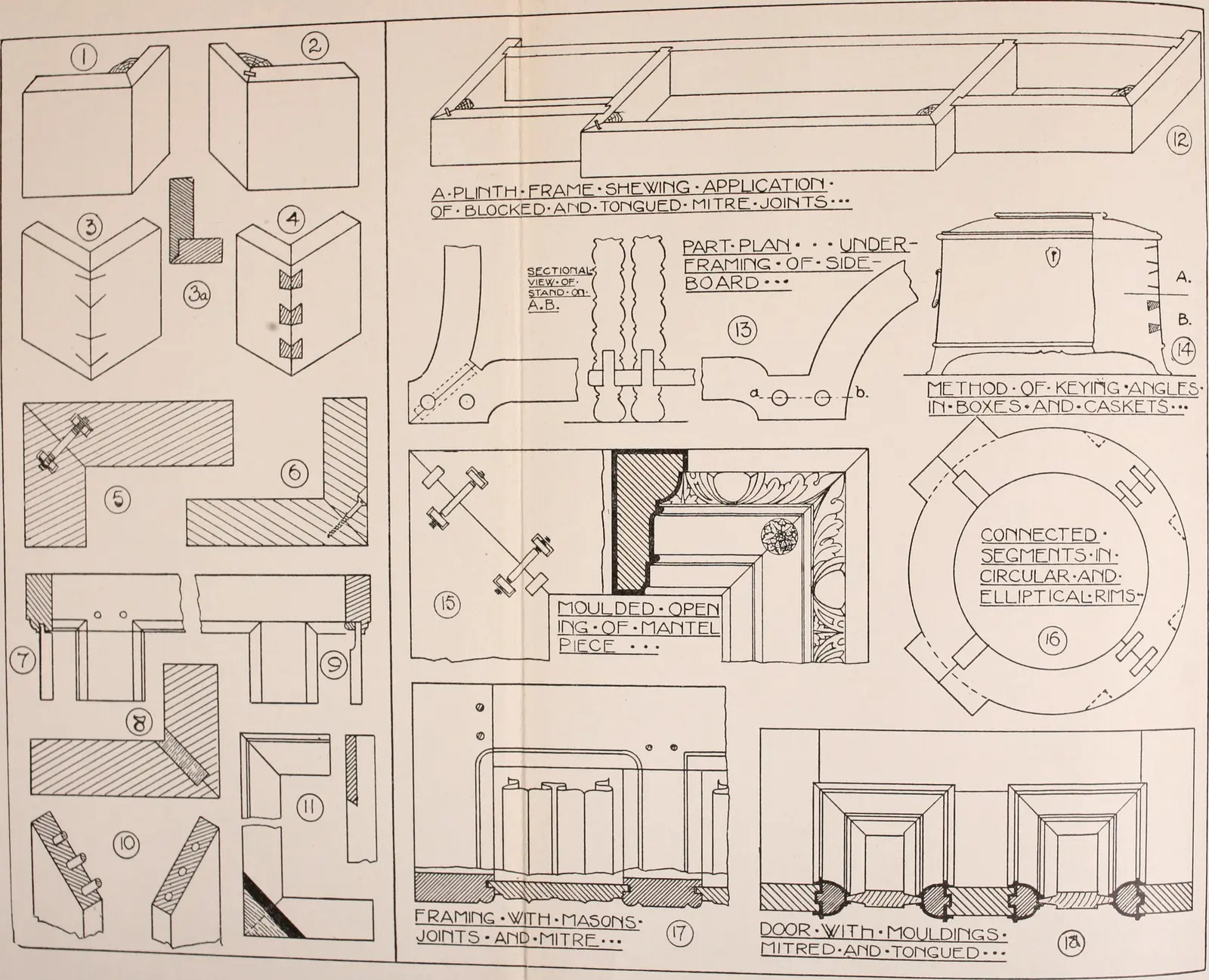
We have not reproduced any of his work. The plate above comes from a 1922 English cabinet-work manual, not from his books.
That closes the first block of this series: nine makers, from Gibbons in the seventeenth century to Pye in the twentieth. Between them they cover carving, joinery, form, teaching, refusal, and the argument for why any of it is worth paying for.