
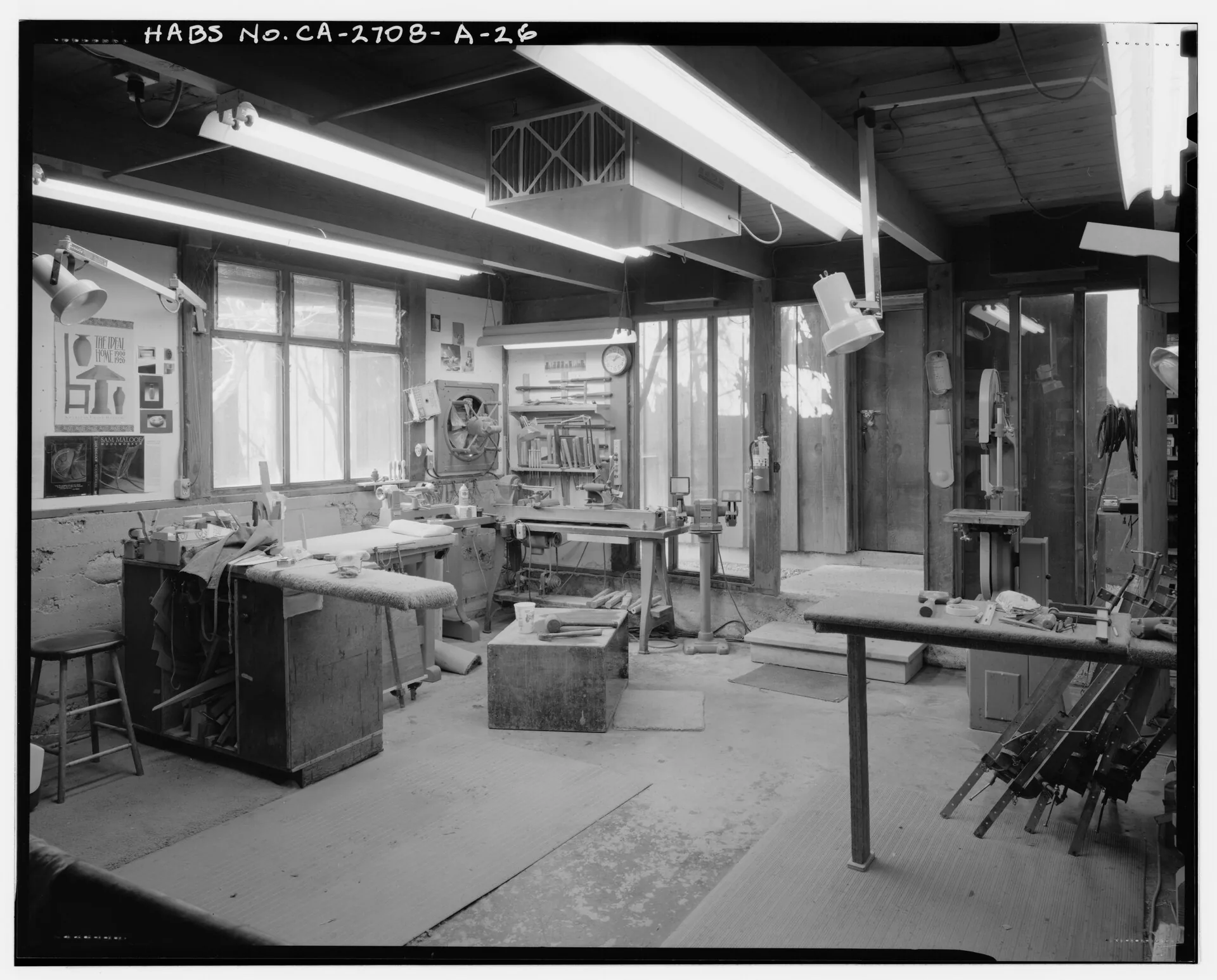
Sam Maloof never took a woodworking class. Not one. He became the first craftsman in history to be given a MacArthur genius grant, and the first living craftsman whose work entered the White House collection.
Everything below follows from that gap between the training he did not have and the work he did.
One. He never had a lesson.
He was born in Chino, California, in 1916, the son of Lebanese immigrants. He served in the Army through the Second World War. Afterwards he worked as a graphic artist, and then as a studio assistant to the artist and designer Millard Sheets in Claremont.
He began making furniture in 1949, and the reason is the least romantic one possible. He and his wife Alfreda had a home and no money to furnish it. So he made what they needed himself, out of whatever material he could get.
He had no training, no teacher, and no tradition behind him. What he had was trial and error, repeated for sixty years.
That matters because of how the story is usually told. People hear "self-taught" and picture a natural, someone who simply had it. That is not what happened. He got there by making a very large number of chairs, most of them not as good as the next one, and by refusing to stop.
In 1985 the MacArthur Foundation gave him a fellowship. No craftsman had ever received one before. A Maloof rocking chair became the first work by a living craftsman ever taken into the White House collection of American furniture, and his work has been shown at the Vatican Museum and sits in the Smithsonian.
Not bad for a man whose formal education in the craft was zero.
Two. The joint that carries his name.
Look at a Maloof rocker where the leg meets the seat. In most chairs this is the ugly compromise: a bracket, a bolt, a block of wood screwed underneath, something hidden because it is not nice to look at.
Maloof made it the most beautiful part of the chair.
The joint he developed interlocks the leg into the seat, and then he sculpted the two into one another so completely that the eye cannot find where one stops and the other starts. It reads as though the chair grew that way. It is also enormously strong, which is the part people forget. That joint is holding a rocking adult, in motion, for decades.
Woodworkers still call it the Maloof joint. Having a joint named after you is roughly the woodworking equivalent of having a theorem named after you.
The way he made it is as instructive as the joint itself. He did not work from detailed drawings. He shaped by eye and by hand, with a bandsaw to get close and then rasps and spokeshaves and sanding to find the final line. The curve was decided by his hands while he was making it, not on paper beforehand.
If you have ever felt guilty for not having a full plan before you cut, Maloof is your defence.
Three. He said no.
This is the section that matters most, and it is the one nobody tells.
Maloof was, by any measure, in enormous demand. Rockers had waiting lists measured in years. Prices climbed and climbed. Anyone with an eye for business could see the obvious move: scale it. License the designs, put them into a factory, sell a thousand Maloof rockers a year instead of a few dozen.
He would not do it.
He kept the workshop small. He worked with a handful of assistants, in Alta Loma, California, making things by hand, at the rate a pair of hands can actually make them. He went on doing it into his nineties. He died in 2009, still working.
Here is the point. The scarcity is not an accident of a small shop that could not grow. It is a decision, made repeatedly, by a man who could have grown and chose not to. And that decision is precisely why a Maloof rocker is worth what it is worth.
The market did not make his work rare. He did.
What to carry forward
Do not wait to be qualified. He had no training and started because he needed a chair. The number of pieces you have finished matters more than the number of courses you have taken.
Make the joint the feature. Everywhere you are tempted to hide a connection, ask what it would take to make that the best-looking part of the object instead. That single instinct produced his entire signature.
Let your hands decide some of it. He drew very little. Some shapes cannot be found on paper, only by cutting and looking and cutting again.
And the hard one. Turning work away is not lost income, it is the thing that makes the rest of your work valuable. Every maker who scaled to meet demand discovered that demand evaporates the moment the thing stops being rare.
A note on sources
Biography and dates follow the Smithsonian American Art Museum, the MacArthur Foundation's own record of the 1985 fellowship, and Craft in America. The Sam and Alfreda Maloof Foundation preserves his home and workshop in Alta Loma, and it is open to visitors, which is the closest thing to seeing how he actually worked.