
Rosanne Somerson arrived at the Rhode Island School of Design to study photography.
She left with a furniture degree. Thirty-nine years after that, she was appointed president of the college.
One. The skill she was leaving behind turned out to be the useful one.
She was born in Philadelphia in June 1954 and started at RISD as a photography major. Somewhere in the first years she found the woodshop, and in that woodshop was Tage Frid, the Danish cabinetmaker from episode nine who had been imported to teach a craft America had forgotten.
She switched, took a BFA in Industrial Design in 1976, and filled the gaps with full-time furniture workshops at the Peter's Valley School of Craft.
Now the part that makes this episode.
When Frid came to produce Tage Frid Teaches Woodworking, the three-volume series that taught joinery to a generation of English-speaking woodworkers, somebody had to photograph every step. Somerson did it.
So the discipline she abandoned is the one that carried her teacher's knowledge out into the world. If you have ever learned a joint from those books, you learned it from Frid's hands and her eye at the same time.
That is worth pausing on, because most people treat a change of direction as a write-off. The photography was not wasted. It was the thing that made her useful to the person she most wanted to learn from.
Two. Somebody has to build the room.
She set up her own studio in 1979 and has been making furniture under her own name ever since, currently out of Fall River, Massachusetts.
Then the other career. She joined the RISD faculty in 1985 and ran the graduate programme in furniture design. In 1995 she co-founded the Furniture Design department outright, and ran it until 2010. In February 2015 the trustees appointed her the college's seventeenth president, and she served until June 2021.
Student, maker, teacher, founder of the department, president of the college. Nobody else in this series has that shape.
It is worth naming what that contribution actually is, because this series is mostly about individual makers and it would be easy to undervalue.
Frid taught brilliantly and then retired, and a teacher's direct influence ends with the last student who sat in the room. A department does not. Somerson built the structure that keeps teaching after any particular teacher has gone, and that is a different and rarer act than making a beautiful chair.
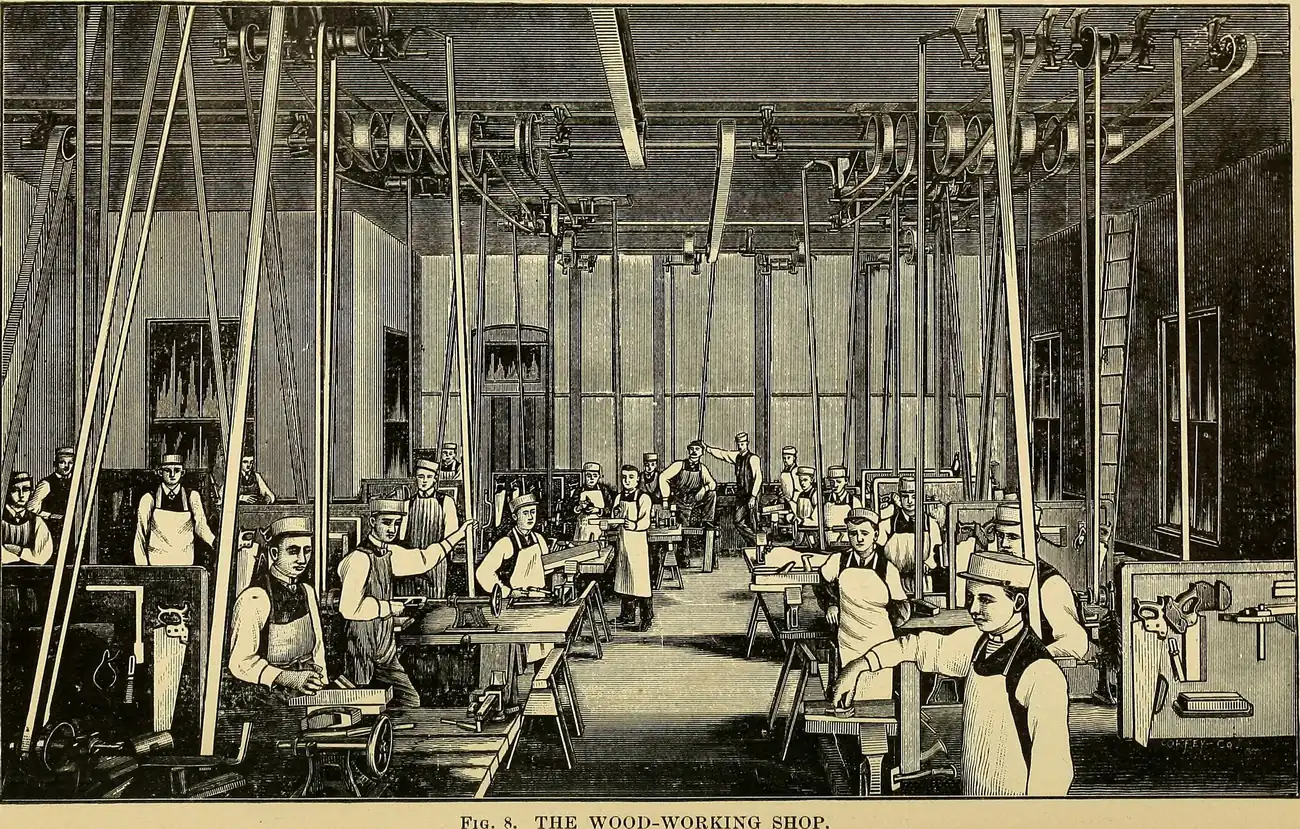
It is worth picturing the rooms the craft built for itself when it was formalising its teaching in the nineteenth century: benches in rows, a master at the front, and not one woman in the building.
Look at that engraving for a second. This is the kind of room the craft built for itself when it was formalising its teaching, and there is not one woman in it. That was not an accident of who happened to show up. It was the design.
The relevant fact about Somerson is not that she overcame it. It is that she ended up in charge of deciding what such rooms look like.
Three. Utility is how the feeling gets in.
In an artist statement from 1991 she wrote that her hope is "to help the viewer find her or his own place of emotive satisfaction, coaxed and guided by the furniture's utility."
Read that carefully, because it is a real position and not decoration.
A painting gets one shot at you, when you are standing in front of it deciding to have an experience. Furniture does not work that way. It gets you every morning, half asleep, when you are not braced for it. The drawer that runs sweetly. The arm your hand finds without looking. Nobody has ever set out to be moved by a chair.
Her argument is that the use is not the compromise you make in exchange for being art. The use is the delivery mechanism. It is the reason furniture can reach somebody in a way a sculpture on a plinth cannot, because it has a thousand chances instead of one.
She was made a Fellow of the American Craft Council in 2009 and received the Furniture Society's Award of Distinction for Lifetime Achievement in 2012.
What to carry forward
The old skill is not dead weight. Photography, welding, code, whatever you did before. It will make you useful in a way the people around you are not, usually sooner than you expect.
Serve the person you want to learn from. She did not ask Frid to mentor her. She made herself indispensable to a project he needed finished. That is the whole method and it still works.
Count the thousand chances. Your piece will be encountered every day for years by somebody not paying attention. Design for the tenth encounter and the thousandth, not the first.
Build something that outlasts you. A workshop, a class, a group of makers who meet on Saturdays. The chairs go to individual houses. A room where people learn keeps going.
A note on sources
Dates, the switch from photography, the 1976 BFA, Peter's Valley, the 1979 studio, the RISD faculty and department years and the presidency from 2015 to 2021 all follow her Wikipedia entry. Her photography for Tage Frid Teaches Woodworking is recorded there too. The 1991 artist statement is quoted from the same source. RISD's own digital archive holds oral history interviews with both her and Frid, which is the best first-hand material on that relationship.
One claim we have left out: several places describe her as RISD's first alumna president. The stronger sources do not confirm it, so we have not repeated it.
She is alive and working, so nothing of hers is reproduced here. The engraving above is from an 1887 account of manual training schools.