
Poul Kjaerholm served a cabinetmaker's apprenticeship in Jutland and qualified in 1948, at nineteen. It is the same training Wegner had, the same training Mogensen had, the same training that produced the whole Danish furniture reputation.
He then spent the next thirty years working almost entirely in steel.
That is not a betrayal of the training. It is the most interesting use anybody in this series made of one.
One. What he actually took from the bench.
Steel furniture in the middle of the twentieth century usually meant tubular steel: bent pipe, chrome plated, bright, industrial in the way a hospital trolley is industrial.
Kjaerholm used flat and square bar, matte brushed rather than chromed, in the thinnest section that would carry the load. His frames read as drawn lines. Then he put natural materials on them: leather, canvas, cane, wicker, marble, wood.
That combination is the cabinetmaker showing. A joiner spends an apprenticeship learning that a member should be no heavier than its job requires, that a surface has a grain and a temperature, and that a piece is judged at arm's length by a hand rather than across a room by an eye. Kjaerholm carried all of that into a different material and refused to let the material make the decisions.
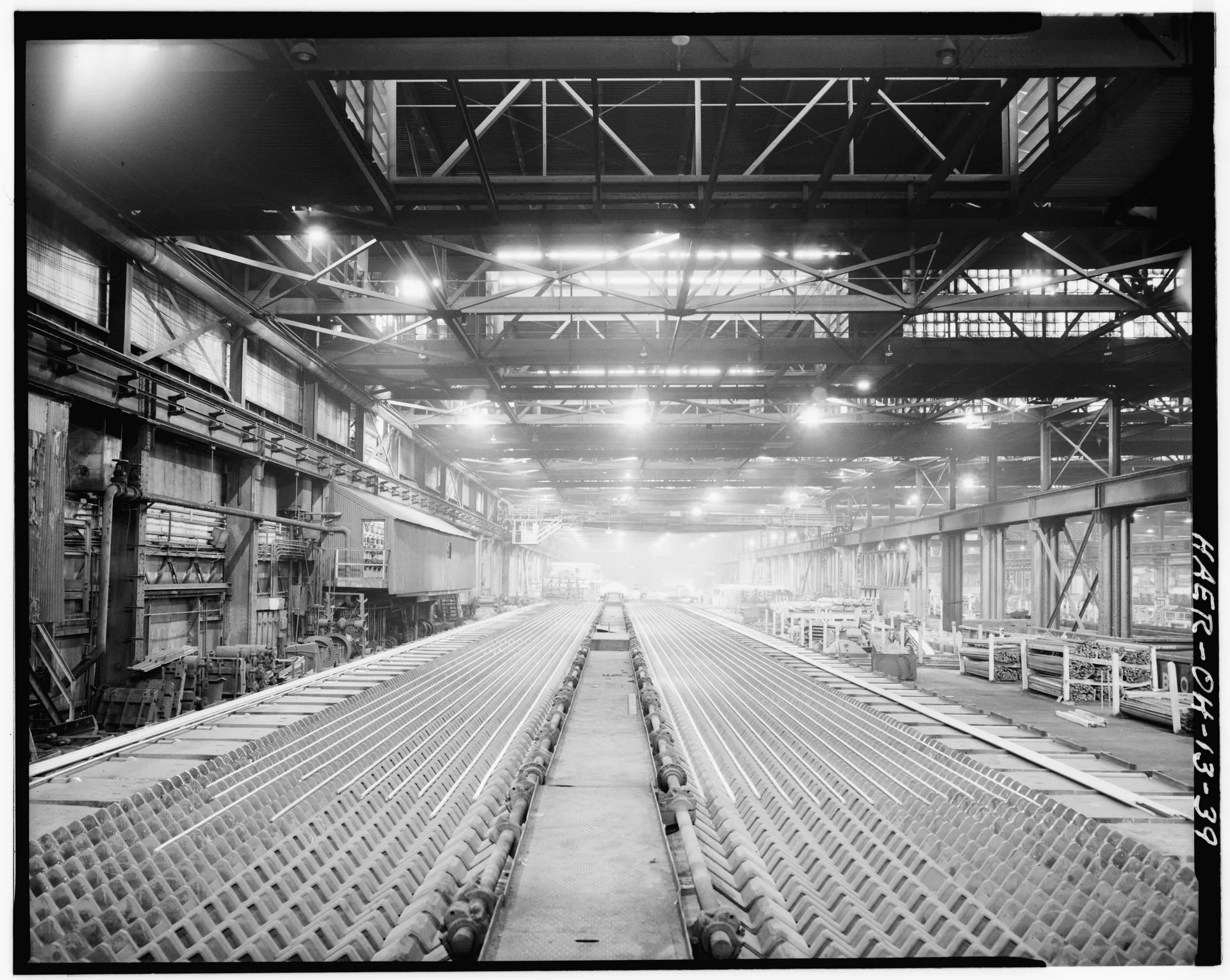
Look at the photograph above. Those are steel rounds cooling on the beds of a bar mill, thousands at a time, identical. That is where his raw stock came from, and it could hardly be further from a plank with a figure in it. He treated it with exactly the care Nakashima gave a slab.
Two. The graduation piece.
His first significant design, PK25, was made in 1951 while he was a student at the School of Arts and Crafts in Copenhagen. It is cut and folded from a single sheet of steel, with no welds in the frame, and the seat and back are made from flag halyard line wound across the opening.
A student made a chair out of one piece of sheet steel and some rope. Nearly seventy-five years later it is still in production.
There is a lesson in that which has nothing to do with steel. The constraint was poverty: one material, no money, no factory. The answer was a technique nobody had used because nobody that broke had been that good.
Three. He stayed small on purpose.
From 1952 his work was produced by Ejvind Kold Christensen, who was not a large manufacturer. Kjaerholm's designs look industrial and were never made industrially in the volume that word implies. The tolerances he wanted were closer to a workshop's than a production line's, and the pieces cost accordingly.
He was awarded the Grand Prix at the Milan Triennale in 1957 and again in 1960. From 1976 he was a professor at the Royal Danish Academy of Fine Arts, running the design institute, teaching the discipline he had come up through.
He died in 1980, aged fifty-one. His output over an entire career is roughly forty designs, most of which are still made. Wegner drew over five hundred chairs and hit a dozen. Kjaerholm drew very few and hit most of them. Both approaches are legitimate and they are the two ends of the same trade.
What to carry forward
Your training is not your material. What an apprenticeship gives you is judgement about proportion, load and touch. That transfers to anything. It is not a licence limited to one substance.
Minimum section. Ask of every member: is this as light as it can be and still do the work? That question is the difference between a frame that looks drawn and a frame that looks safe.
Warm where the body lands. His frames are cold and hard, and every surface that touches a person is leather, cane, canvas or wood. That division is doing enormous work and it costs nothing to copy.
Poverty is a design brief. One sheet of steel and a length of rope is not a limitation you overcome, it is the thing that forced the idea.
A note on sources
His birth in 1929, the cabinetmaker's apprenticeship completed in 1948, his study at the School of Arts and Crafts in Copenhagen and the PK25 chair of 1951, the long production relationship with Ejvind Kold Christensen from 1952, the Milan Triennale Grand Prix awards of 1957 and 1960, his professorship at the Royal Danish Academy of Fine Arts from 1976 and his death in 1980 are documented by Fritz Hansen, who has produced the collection since 1982, and by the standard literature on Danish design.
His estate is live and the designs are still in production, so none of his work is reproduced here. The photograph above is an American steel mill recorded by the Historic American Engineering Record, and it is here because it shows the material as it actually arrives: anonymous, identical, and nothing like a board.
That closes the Scandinavian block. Six makers, one apprenticeship system, and six completely different answers to what a chair is.