
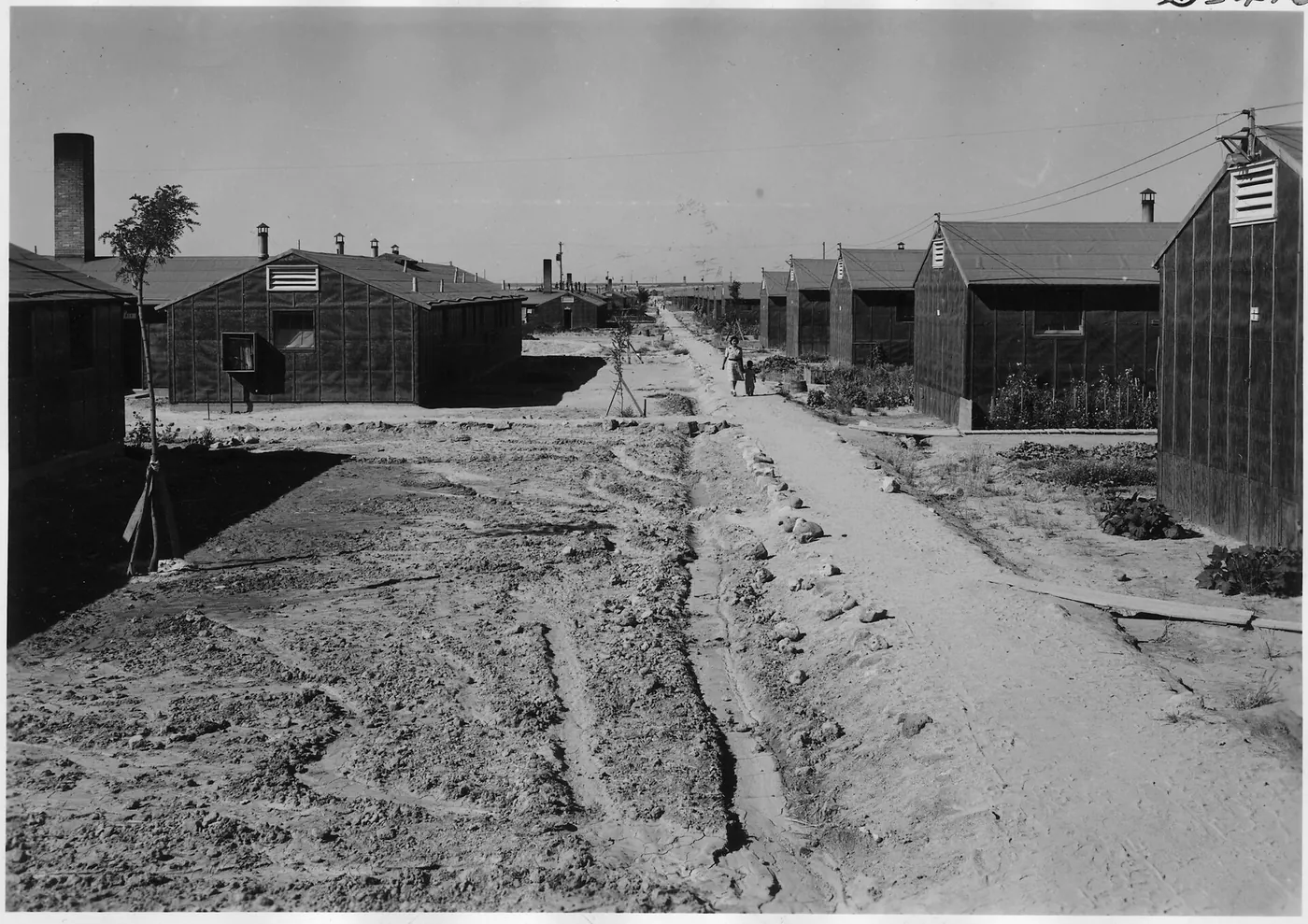
In episode one, this series described George Nakashima learning Japanese joinery from a carpenter interned alongside him, and mentioned in passing that the studio is still running today under his daughter, who had been a baby in the camp.
This is her episode.
One. The baby in the camp.
Mira Nakashima was born in Seattle in 1942. At six weeks old she was sent with her parents to the Minidoka War Relocation Center in Idaho, one of the ten camps built under Executive Order 9066, the order Wendy Maruyama made 120,000 paper tags about in episode ten.
The family was released in 1943 when the architect Antonin Raymond arranged work for George on his farm in New Hope, Pennsylvania. That is how the studio ended up where it is.
She graduated from Harvard in 1963 and took a master's in architecture at Waseda University in Tokyo in 1966. She joined the family business in 1970.
Her father died in 1990. She has been running it ever since, which now means she has led the studio for longer than he did.
Two. The hardest brief in the craft.
Consider what she inherited.
A style so distinctive it is recognisable across a room. A name that functions as a guarantee. A body of work in major museums. A client list. And a father who was not only a great maker but an articulate one, who had written down what he believed about wood in a way that left very little room for revision.
Now make new furniture.
Do it in the same idiom and you are a copyist trading on a dead man's name. Break from it and you have thrown away the thing that gives the studio its meaning, and you will be told so by everybody who owned a piece before you took over.
There is no clean answer to this, and it is worth naming because the craft romanticises inheritance without ever asking what it costs. Every maker with a famous parent, every second-generation workshop, faces the same trap. Mira Nakashima has navigated it for over thirty years by continuing the vocabulary while designing new work within it, including pieces that are plainly hers rather than his.
Three. The studio as the work.
The New Hope site is now a complex of twenty-one buildings and a National Historic Landmark. She is president and creative director, and also president of the Nakashima Foundation for Peace, the project her father began late in life to place Altars for Peace on every continent.
Notice what this episode has in common with Somerson at twelve and Fredell at fourteen. The contribution is not only objects. It is keeping an institution alive, which is unglamorous, mostly administrative, and the reason anything survives its maker.
A workshop that outlives its founder is rare. Most close within a year or two, because the knowledge lived in one person's hands and the business lived on one person's name. That Nakashima Woodworkers is still producing, on the same site, with the same timber inventory approach, is a deliberate achievement by somebody who chose to spend her career on it.
What to carry forward
Inheriting a style is a constraint, not a gift. If you ever take over someone else's practice, decide early and explicitly how much you are continuing and how much is yours.
Write down what you know. George Nakashima's philosophy survived because he articulated it. Knowledge that stays in your hands dies with your hands.
Keeping something alive is real work. It looks like admin and it is the difference between a workshop and a memory.
Your own history is material. The camp is in the studio's story because the family did not hide it. What is difficult in your own background is usually the part that makes the work mean something.
A note on sources
Her birth in 1942, Minidoka, the release in 1943 arranged by Antonin Raymond, the Harvard degree of 1963, the Waseda master's in architecture in 1966, joining the studio in 1970 and taking over after her father's death in 1990 follow her Wikipedia entry and the George Nakashima Woodworkers history pages. The National Historic Landmark designation and the Foundation for Peace are recorded by the studio and the foundation.
She is alive and working, so nothing of hers or her father's is reproduced here. The photograph above is of Minidoka, made by the U.S. government that built it.