
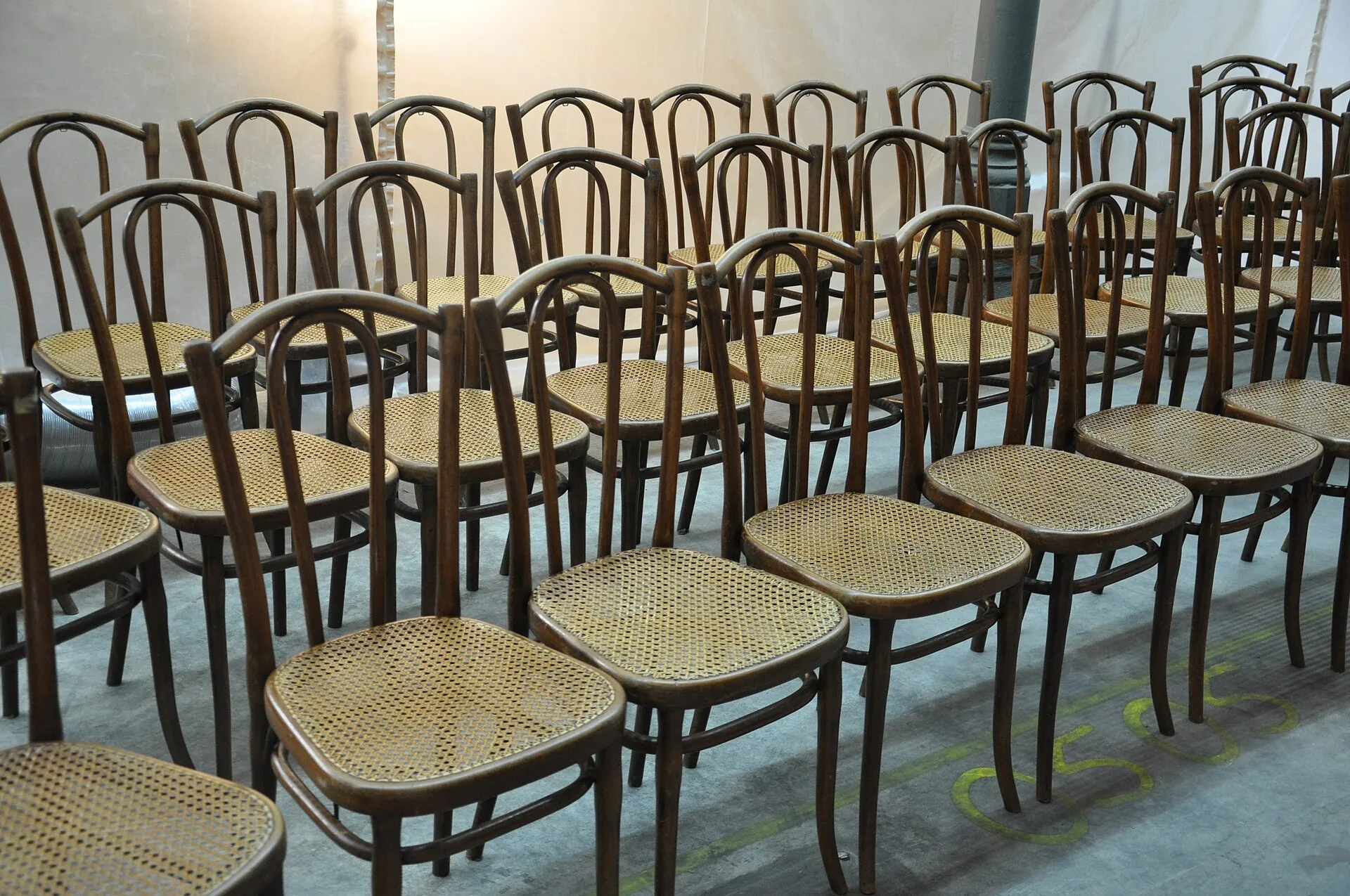
Count the chairs above. Then notice that they are the same chair.
Michael Thonet worked out how to make furniture that could be produced by the hundred thousand, shipped flat across an ocean, and assembled at the far end by somebody with a screwdriver. He did it in the 1850s. The rest of the furniture trade took another century to catch up, and one Swedish company got the credit.
One. He lost everything first.
He was born in Boppard on the Rhine in 1796 and set up as a cabinetmaker there. Through the 1830s he experimented with bending wood: gluing bundles of thin veneer and forcing them into forms, which produced curves no sawn timber could give and used far less material.
He patented it in 1841. He also went broke doing it, and his creditors took the workshop.
Then in 1842 Prince Metternich saw the work, and invited him to Vienna. He moved his whole family, worked on the floors and furniture of the Palais Liechtenstein, and in 1849 opened his own workshop again. In 1853 he transferred the firm to his five sons and it became Gebrueder Thonet, the Thonet Brothers.
He was fifty-seven before the business that made him famous existed.
Two. The chair with six parts.
His real breakthrough was giving up on laminated veneer and steaming solid beech rods instead, then bending them in iron forms. Cheaper, faster, stronger. In 1856 the firm built a factory at Koritschan in Moravia, sited next to the beech forests, because moving the timber was the expensive part.
In 1859 came Chair No. 14.
Six pieces of bent wood, ten screws and two nuts. No joinery to cut. No fitting. A worker did not need to be a cabinetmaker, and the parts arrived at the assembly bench interchangeable.
Then the shipping trick. The chairs went out disassembled, and thirty-six of them fitted into a box of one cubic metre. A single crate crossed the Atlantic carrying three dozen chairs instead of three.
By 1930 something like fifty million had been sold. It is probably the most-produced chair in history, it is still made, and if you have sat in an old cafe anywhere in Europe you have sat in one.
Three. What he actually designed.
He did not design a chair. He designed a system, and the chair fell out of it.
Look at the chain. A bending method that needs no expensive timber. A factory placed in the forest so the raw material does not travel. A design reduced to six parts so unskilled hands can build it. A part count and geometry that lets it ship flat. And a form plain enough that nobody's taste rules it out.
Every one of those decisions is about something other than how the chair looks, and together they are why it looks like that.
Eight episodes ago, Alvar Aalto took the same material problem and answered it with lamination and glue, seventy years later, for a tuberculosis sanatorium. Thonet's answer was volume. Aalto's was a specific human body. Both are correct, and the difference between them is the difference between designing for a market and designing for a person.
Michael Thonet died in Vienna in 1871.
What to carry forward
Count the parts. Then take one out. Six pieces and ten screws is a target, not a historical curiosity, and every part you remove is a jig, a stock item and a failure point removed with it.
Design for the crate. How the thing travels is a design constraint from the first sketch, not a packing problem at the end. Thirty-six in a cubic metre is a design decision.
Put the workshop next to the material. He built in the beech forest. The equivalent question for us is what we are paying to move, and whether we have to.
Going broke is not the end of it. He lost his workshop to creditors and started again in another country in his forties. The thing he is famous for came after that.
A note on sources
His birth at Boppard in 1796, the experiments with laminated bentwood in the 1830s and the patents of 1841, the loss of the Boppard workshop to creditors, Metternich's invitation and the move to Vienna in 1842, the work at the Palais Liechtenstein, the founding of Gebrueder Thonet in 1853, the Moravian factory of 1856, Chair No. 14 of 1859 and his death in 1871 are documented by Thonet, who still make the chair, and by the Museum of Applied Arts in Vienna.
The often-quoted figures, six parts with ten screws and two nuts, thirty-six chairs in a cubic metre, and roughly fifty million sold by 1930, are the standard account given by the company and repeated throughout the design literature. We have not seen a primary source for the fifty million and treat it as an order of magnitude rather than a count.
The chairs in the photograph are the original seating of the Konzerthaus in Ravensburg. They are bentwood chairs of the Thonet type rather than a documented single model, which is exactly the point of the episode.
He died in 1871, so the work is long out of copyright.
That is thirty makers. It began with a seventeenth-century carver in England and has arrived at a man who worked out how to put a decent chair in fifty million rooms.