
At eighteen, Kristina Madsen went looking for someone to teach her to make furniture, and found an eccentric Englishman working alone in a converted potato barn in central Massachusetts.
His name was David Powell. He had trained in Edward Barnsley's Arts and Crafts workshop in England before emigrating, and he agreed to teach her.
Word got out. Other people started asking for the same arrangement, and in 1977 Powell and John Tierney opened the Leeds Design Workshops in a mill building in Easthampton. A school grew out of one teenager asking a man in a barn for lessons.
One. Four years, one teacher.
Madsen trained under Powell from 1975 to 1979. Four years, traditional European cabinetmaking, in the direct line from Barnsley's Arts and Crafts workshop.
That is worth placing against the rest of this series. She and Tage Frid are the only two who came up through anything resembling a real apprenticeship, and Frid's was in Denmark in the 1920s. Madsen's happened in Massachusetts in the 1970s, when the American craft world had mostly settled on degree programmes.
Afterwards she taught part time and set up her own furniture business in Southampton, Massachusetts, where she has now been making for over forty years.
For most makers, that would be the whole story: excellent training, classical forms, impeccable joinery, a long career. What happened next is what puts her on this list.
Two. She went to Fiji to learn how to carve.
In 1991 she won a Fulbright grant and spent nine months in Fiji studying with a master carver named Makiti Koto.
Notice the direction of travel. The usual craft story runs the other way, with Western makers treating other traditions as a source of motifs to borrow at a distance. Madsen went and put herself back in the position of a beginner, at thirty-something, with a completed European training already behind her, and learned a living tradition from the person who held it.
What she learned was freehand intaglio: carving in which every engraved line sits below the surface of the wood. No relief standing proud, no material added. The pattern is cut down into the surface and the surface stays whole.
Since 1991 that technique has been on essentially all her furniture. Not applied as a panel or a feature, but worked across the surfaces of pieces whose forms remain classical and restrained. The proportions are Barnsley by way of Powell. The skin is what she learned in Fiji.
Set her next to Gibbons at episode two. Gibbons cut limewood free of the panel behind it until it stood almost clear of the wall, the most extreme relief carving anyone has managed. Madsen goes in the opposite direction, everything below the surface. Both are carving. They are opposite answers to the same question about where a pattern should live.
Three. Restraint plus intensity.
The combination is unusual and it is the reason her work is difficult to imitate.
Most furniture picks a side. Either the form is quiet and the surface is left plain, which is the modernist position, or the form is elaborate and the ornament piles on, which is most historical furniture. Madsen makes a quiet form and then covers it in an extraordinarily labour-intensive incised pattern.
The result reads as calm from across a room and reveals itself entirely differently at arm's length. That is a real design strategy and almost nobody uses it, because it requires you to do an enormous amount of work that does not announce itself.
She has received the Furniture Society's Award of Distinction, and in 2022 a Maxwell/Hanrahan Foundation award of one hundred thousand dollars. Her work is in the Smithsonian American Art Museum, which holds one of her dining chairs.
What to carry forward
Ask the person directly. She was eighteen and she went and found the maker she wanted to learn from. That is still the fastest route into a craft, and it is available to anyone willing to be told no.
Be a beginner again on purpose. She had a complete European training and went to start over in a technique she did not know. Most careers stall precisely because that becomes unthinkable.
Learn from the source, not from photographs. There is a difference between borrowing a motif and being taught a tradition. One is decoration, the other is transmission.
Try the opposite of relief. If you carve, you almost certainly carve outward. Everything below the surface is a whole vocabulary most Western woodworkers never touch.
A note on sources
Her training with David Powell from 1975 to 1979, the potato barn, the founding of Leeds Design Workshops in 1977 by Powell and John Tierney, the 1991 Fulbright to Fiji, Makiti Koto and the intaglio technique all follow Fine Woodworking's profile of her and the Furniture Society's Award of Distinction citation. The 2022 Maxwell/Hanrahan award is recorded by that foundation and by the Daily Hampshire Gazette. Her dining chair is in the Smithsonian American Art Museum's collection.
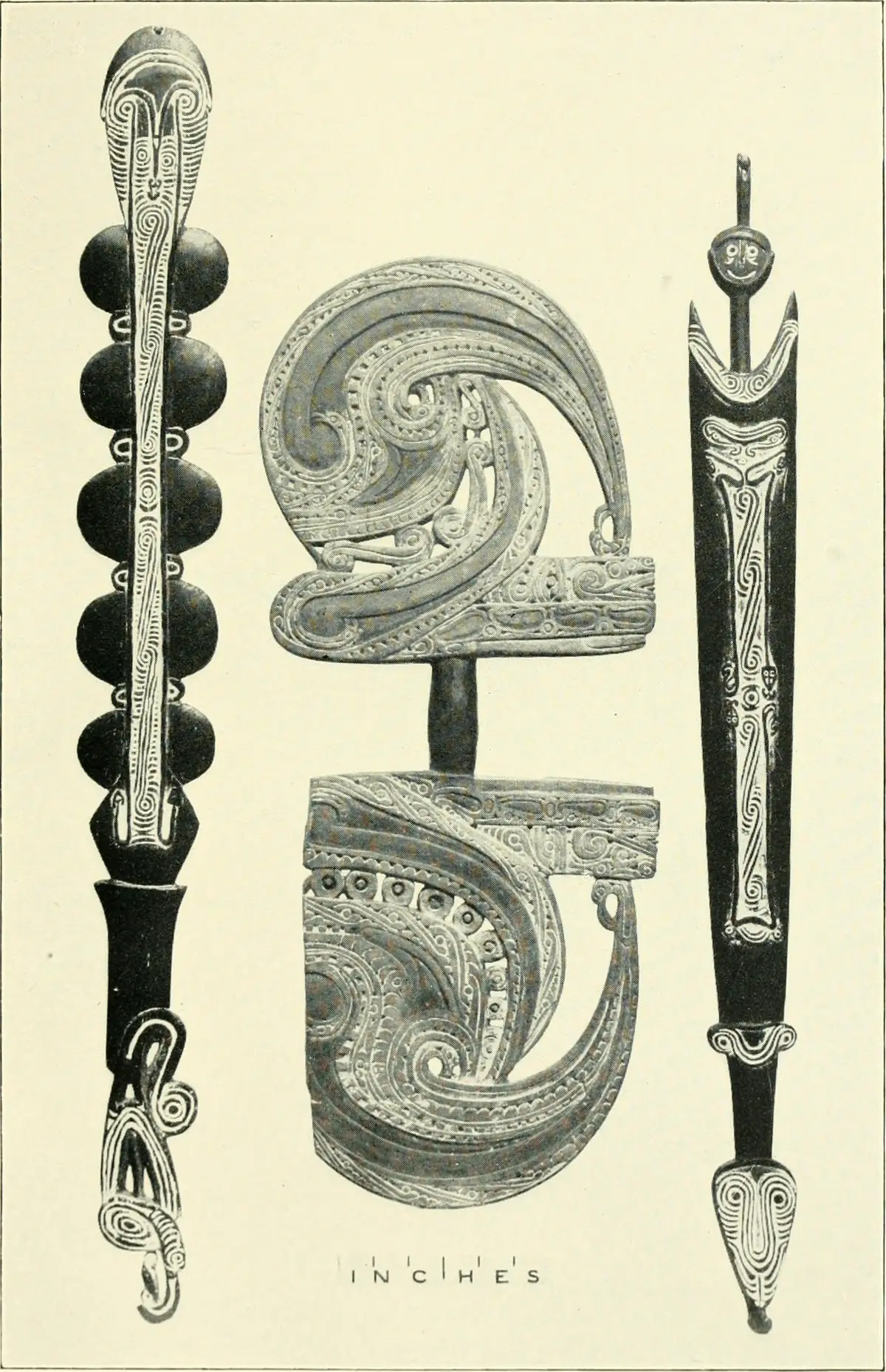
She is alive and working, so nothing of hers is reproduced here. On the image: we could not verify a public-domain photograph of Fijian carving. The plate above shows Maori objects from a British Museum handbook, and is labelled as such rather than passed off as something it is not.