
Everything the world calls Danish modern comes out of one teacher, and he taught by making his students measure things.
Kaare Klint was born in 1888 and died in 1954. In 1924 he became the founding head of the furniture school at the Royal Danish Academy of Fine Arts, and almost every significant Danish designer of the next generation passed through it, including Borge Mogensen in the next episode.
His method was so plain it sounds like nothing. It changed the field.
One. Measure the old furniture.
Klint had his students take historical furniture, English eighteenth century in particular, and measure it. Not copy it. Measure it, then work out why the dimensions were what they were.
The reasoning: furniture types that had survived several centuries had been refined by generations of use. A Chippendale chair was not arbitrary. Its seat height, depth, back angle and arm position had been adjusted by thousands of makers responding to thousands of complaints, and what survived was a solution.
So rather than inventing from scratch in the modernist manner, Klint proposed studying what already worked, extracting the proportion, and rebuilding it clean.
This is why Danish modern feels different from other modernism. Much of the movement elsewhere was a deliberate break with the past, generating forms from theory. Klint's people were doing something closer to reverse engineering. The results look modern and sit like antiques, because the proportions are inherited.
Two. Then measure the people, and the plates.
The second half of the method is the part almost nobody expects.
Klint applied the same measuring to the human body and to household objects. How wide is a person across the shoulders when seated. How far can an arm reach. And then, most memorably, how big is a dinner plate, a shirt when folded, a stack of bed linen.
He then sized storage furniture to those actual dimensions rather than to a pleasing exterior proportion. A cupboard was designed from the inside out, starting with what would go in it.
That sounds obvious and is still rare. Most storage furniture is designed as an object and the interior is whatever is left over, which is why so many cupboards waste a third of their volume in air nobody can use.
He was doing systematic anthropometrics for furniture in the 1920s, well before ergonomics existed as a discipline. And the raw material was a tape measure and a willingness to count plates.
Three. The teacher effect.
Klint's own output was not large. His influence is enormous, because he taught, and because the method he taught could be handed on intact.
This series keeps arriving at the same finding. Frid at nine, Somerson at twelve, Fredell at fourteen, Mira Nakashima at seventeen. The people whose effect is largest are frequently not the ones with the biggest body of work. They are the ones who built a way of working that other people could pick up.
A method is more transmissible than a style. A style produces imitators, and their work is worse than the original by definition. A method produces practitioners, whose work can be better than their teacher's. Klint's students went on to make furniture more famous than his own, which is the correct outcome and one he would probably have regarded as the point.
What to carry forward
Measure something that already works. Before designing a chair, go and measure three chairs people actually like sitting in, and write the numbers down. This is nearly free and almost nobody does it.
Design storage from the inside out. Start with the objects that will go in. The exterior proportion is a consequence, not a starting point.
Old solutions encode centuries of complaints. A form that survived three hundred years solved problems you have not thought of yet.
Teach a method, not a look. If you ever teach anybody anything, give them a way of deciding rather than a set of shapes.
A note on sources
Klint's dates, the founding of the furniture school at the Royal Danish Academy of Fine Arts in 1924, his teaching method of measuring historical furniture and his anthropometric studies of household objects are standard in the design-history literature on Danish modernism. Where a specific dimension or date matters to you, go to that literature rather than to us.
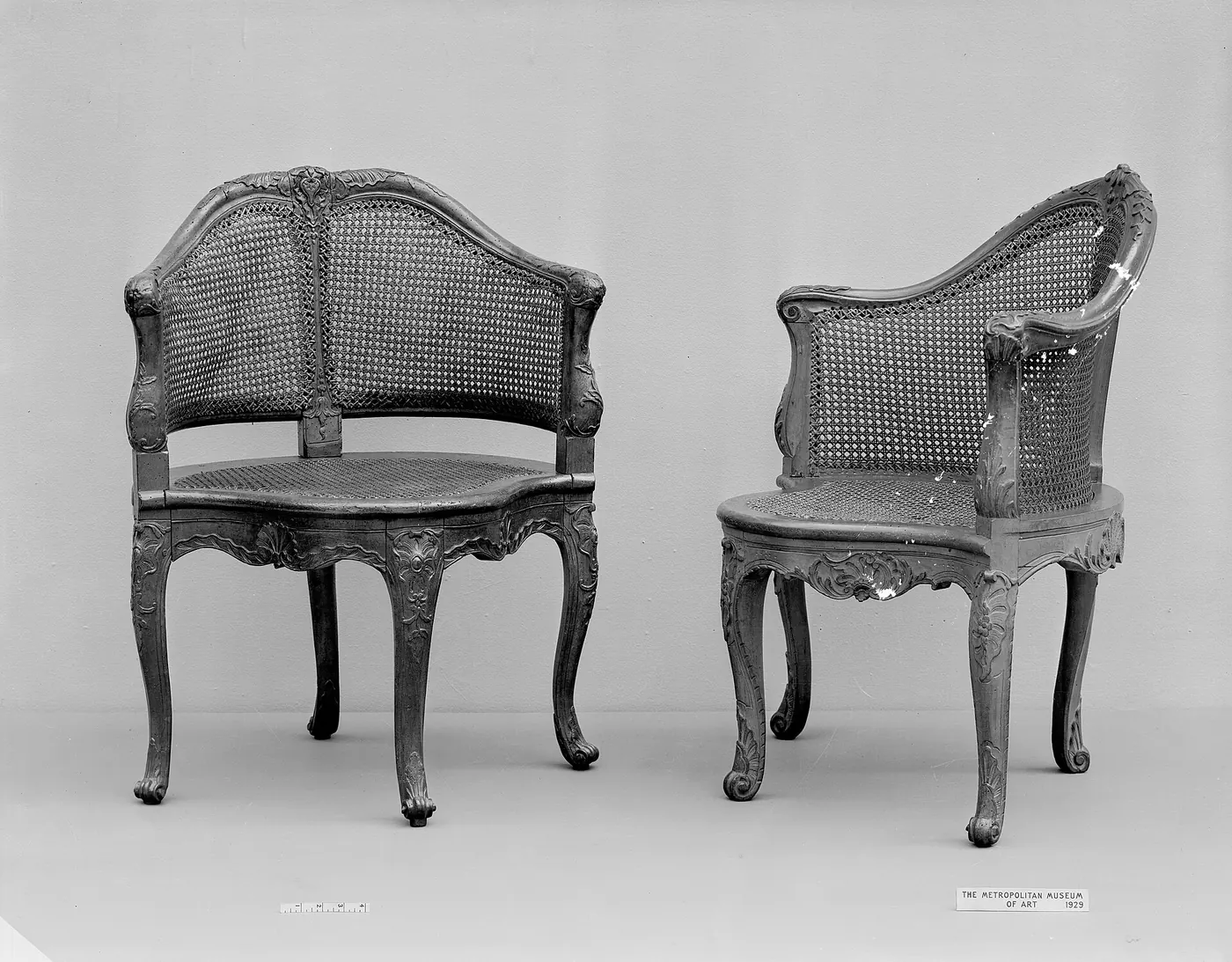
The chair above is in the Metropolitan Museum of Art and is not one of his: it is the kind of object his students were sent to measure.