
Judy Kensley McKie makes furniture with animals in it. Tables held up by dogs. A rocking chair whose rockers are rattlesnakes. Leopards, birds, fish, all carved into and out of the structure.
In a field that spends most of its time being tasteful, she has spent fifty years making furniture that is funny, and it has ended up in the Smithsonian.
One. Eleven years before she found it.
She was born in Boston in 1944. Her father was a graphic designer with a woodshop, and she worked in it as a girl, which is where the interest starts.
She took a BFA in painting at the Rhode Island School of Design in 1966. Painting, again. That is Esherick, Castle and now McKie, three of eleven makers in this series who came to furniture from a fine art training rather than a trade.
In the late 1960s she joined a cooperative workspace in Boston called New Hamburger Cabinet Works. This is a fourth way into the craft, distinct from the three this series has already covered. Not an apprenticeship, not a degree programme, and not solitary self-teaching. A shared building with other makers in it, where you learn by trial, error, and looking sideways at what the person at the next bench is doing.
Now the part worth sitting with. She graduated in 1966. She began carving low-relief animals and plants into furniture in 1975, and the style people recognise as hers arrives around 1977.
That is eleven years of competent, unremarkable work before the thing that makes her herself turns up.
Nobody puts that in a biography, but it is the most useful fact on this page. The voice is not what you start with. It is what is left after a decade of making things that were fine.
Two. The animal is not decoration.
The easy misreading of McKie is that she carves nice animals onto furniture. Look again and the relationship is the other way round.
The dogs are not on the table. The dogs are the table, because they hold it up. The rattlesnakes are not painted on the rockers. They are the rockers. The animal is doing structural work, and the joke only lands because the engineering is real.
That distinction separates her from a century of furniture with pictures stuck on it. Applied ornament sits on the surface and can be scraped off without the piece caring. Hers cannot be removed, because the piece would fall over.
She got there through ancient art. As a painter she was drawn to figurative work from old cultures, and that is not a stylistic borrowing so much as a return to the original position.
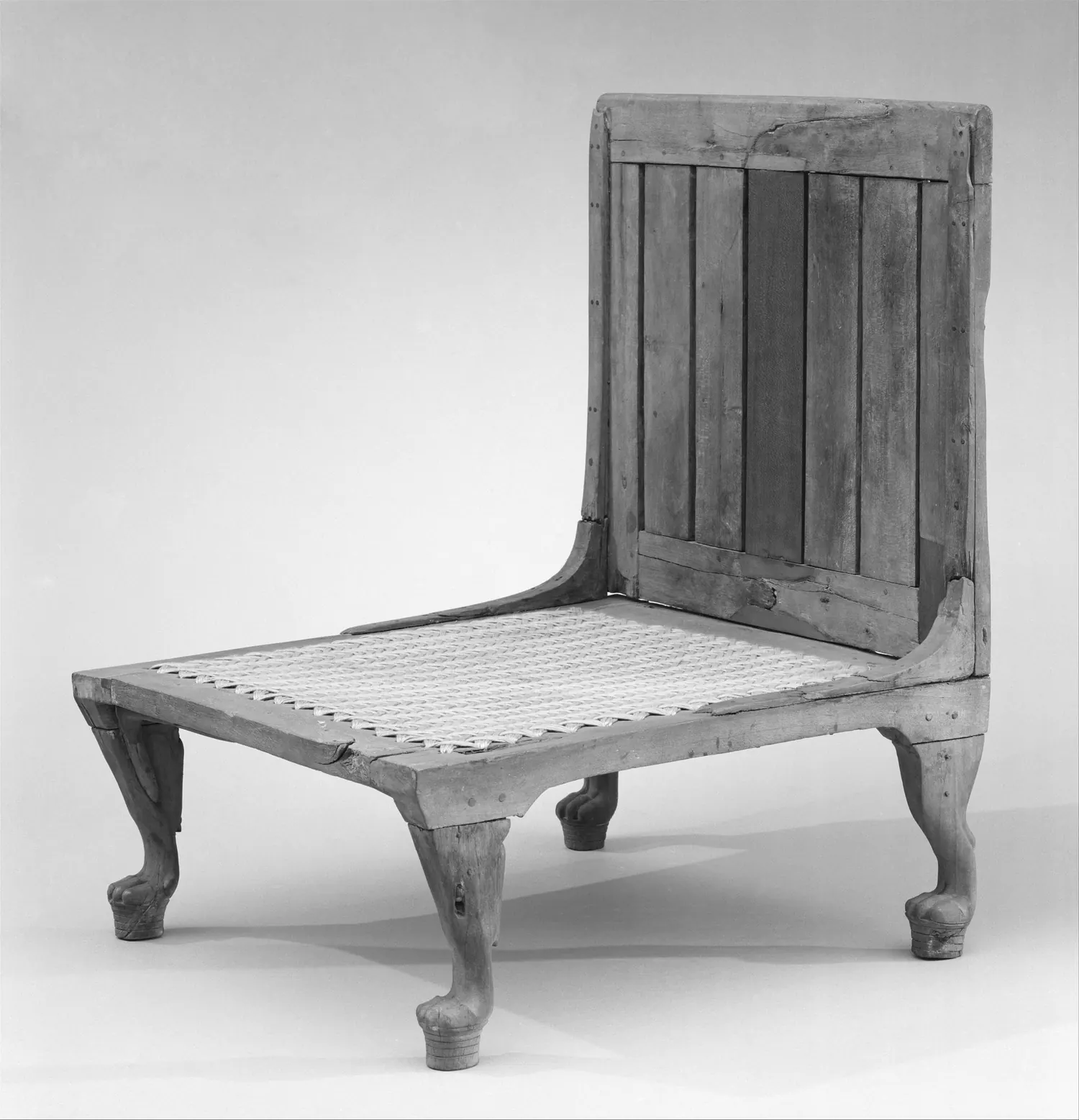
The Egyptians did this. Their chairs and beds stand on lion legs, ending in carved paws, and nobody at the time regarded it as whimsical. Furniture that stands on the legs of a beast is one of the oldest ideas in the craft.
What actually happened is that modernism trained it out of us. A century of good design education taught that ornament was dishonest and form should follow function, and an entire vocabulary got quietly forbidden. McKie did not invent something new. She noticed a prohibition and ignored it.
Three. Humour is a serious position.
There is very little funny furniture. Think about how strange that is, given that furniture lives in houses with people who laugh in them.
Part of it is money. A serious piece is easier to sell as an investment than a witty one, and makers learn that early. Part of it is status anxiety, because craft spent decades arguing it deserved to be treated as art, and jokes felt like a risk to that argument.
McKie made the jokes anyway, and the recognition arrived regardless: NEA fellowships in 1979 and 1982, a Massachusetts Artists Foundation fellowship in 1980, the Louis Comfort Tiffany Foundation Award in 1989, Fellow of the American Craft Council in 1998, the Furniture Society's Award of Distinction in 2005, and the Gold Medal for Consummate Craftsmanship in 2022. Her Leopard Chest is in the Smithsonian American Art Museum.
Which suggests the caution was never necessary.
What to carry forward
Give it eleven years if that is what it takes. Her signature arrived a decade after art school. Work that is merely competent is not wasted time, it is the material the voice gets made out of.
Make the ornament structural. If the decorative element could be removed without the piece caring, it is applied. If removing it would drop the piece on the floor, it is architecture. The second one is far harder and worth vastly more.
Check what you were taught not to do. Most makers carry a set of prohibitions absorbed from design education and never examined. Ornament, colour, figuration, humour. Some are wisdom. Most are fashion.
Find the next bench. She learned in a shared workshop with other makers, not alone and not in a classroom. That model is still the fastest way in for most people, and it is worth more than any single course.
A note on sources
Dates, the RISD degree of 1966, New Hamburger Cabinet Works, the 1975 start of the carved motifs and the awards all follow her Wikipedia entry and the Furniture Society's Award of Distinction citation. Gallery NAGA in Boston and Moderne Gallery both hold current biographical material, and the Smithsonian American Art Museum records the Leopard Chest.
She is alive and working, so nothing of hers is reproduced here. The chair above is Egyptian, in the Metropolitan Museum of Art, and predates her by roughly three and a half thousand years.