
James Krenov did not touch a cabinetmaker's bench until he was thirty-seven years old.
He was born in 1920 in Uelen, the easternmost village in Siberia. His family fled the Russian Revolution the year after, went to Shanghai, and then to remote Alaska, where his parents taught school. Seattle after that. Sweden in 1947. He worked with ships and as a Russian interpreter, and he was well into middle age before he had any idea what he was going to do with his life.
Then in 1957 he walked past a shop window in Stockholm and saw furniture by Carl Malmsten. He went in and asked who had made it. He enrolled at Malmsten's school, studied for two years, and started work in the basement of his house in Bromma.
One. Late is not the same as behind.
Read that timeline again, because it is the most useful thing on this page.
He began at thirty-seven, in a basement, with two years of schooling, in his fourth country and his third language. He then spent the rest of his life becoming the most quoted cabinetmaker of the twentieth century.
The thing that made him was not an early start. It was that when he found the work, he did not treat the previous thirty-seven years as time lost. He had grown up between Siberia, China, Alaska and Sweden. He had a painter and architect for a grandfather. He arrived at the bench already able to look at things, which is the part most people never acquire.
In 1976 he wrote A Cabinetmaker's Notebook. It was not a manual. It was a book about what the working life of a maker feels like from inside. Hundreds of people wrote to him because they recognised themselves in it, which is a thing that essentially never happens to woodworking books. Three more followed quickly: The Fine Art of Cabinetmaking in 1977, The Impractical Cabinetmaker in 1979, Worker in Wood in 1981.
He was sixty-one when he moved to Fort Bragg, California, and in the autumn of that year, 1981, twenty-two students walked into a new building on Alger Street for the first year of the College of the Redwoods fine woodworking programme. He taught there for over twenty years and retired in 2002. It is called the Krenov School now.
Two. The plane comes first.
Here is the technique worth taking, and it is a strange one.
Krenov started nearly every class he ever taught, anywhere in the world, by having his students make a hand plane. Not a box, not a joint, not a practice dovetail. A tool.
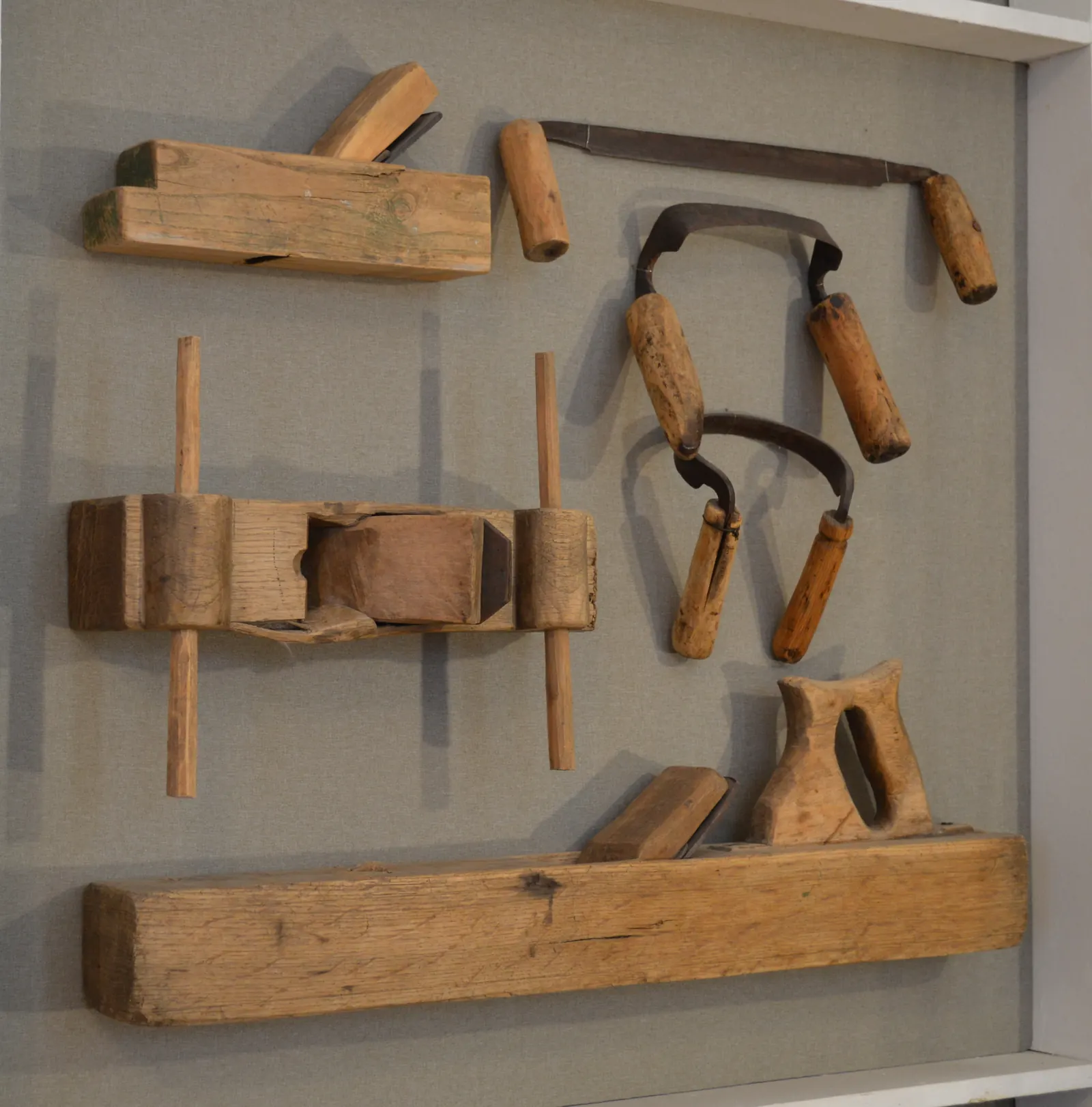
The design is simple on purpose: a wooden body built up from laminated pieces, sides glued to a centre section that has been cut in two and angled, a cross pin to hold a wedge and a blade. People call them Krenov planes now. You can make one in a day.
Ask why he insisted on it, because the answer is not sentimental.
A plane you made is a plane you understand. You can adjust the mouth, re-true the sole, change the angle, make another one narrower for a job that needs it. A bought plane is a fixed object you must work around; a made plane is a variable you control. Every surface you produce for the next thirty years passes under it.
And it puts a tool in your hands before you have earned it, which is a good trick. On day one you have made something that works. Nobody's first plane is beautiful. It still cuts.
The deeper reason is that a wooden plane tells you things a machine cannot. You hear the cut change before you see it. You feel the grain reverse a fraction of a second before it tears. Krenov's whole method was built on that channel of information, and you cannot get it through a sanding drum.
Three. The friendly mystery.
That was his phrase for wood, from an article he wrote in 1966. Not "material." Not "substrate." A mystery, and a friendly one.
He worked small. Cabinets on stands, mostly: delicate cases lifted on thin legs, doors coopered from staves so they curve, drawers fitted so they sigh when you close them. Nothing about them is loud. They are about as far from a statement piece as furniture gets, and they are also unmistakable across a room.
His method was to let the wood have a vote. He would keep a board for years until he knew what it wanted to be. He chose pieces for what they said rather than what they cost. The word his students use about him is not "precise," it is "sensitive."
Now put that next to the last episode.
Garry Knox Bennett hammered a bent nail into his finest cabinet to say that makers had become too precious. Krenov is exactly the maker he was aiming at: the sensitivity, the reverence, the years spent listening to a board.
They are both right, and that is not a dodge.
Bennett is right that reverence can curdle into paralysis, and that a piece which exists to demonstrate your sensitivity is a piece about you. Krenov is right that speed and confidence produce a great deal of loud, forgettable furniture, and that the difference between good and extraordinary is almost always in the part nobody notices.
The useful position is to take Krenov's attention and Bennett's nerve. Listen hard, then cut anyway.
The ending, which is worth knowing.
By 2006 his eyesight had gone too far for cabinetmaking. He could no longer see well enough to do the work that had defined him for fifty years.
So he made planes. Just planes, one after another, because that he could still do by hand and by feel, the same object he had started every one of his students on. In July 2009 an accident with a router closed the shop for good. He died that September, a month short of eighty-nine.
There is a version of that story that is sad. There is another version, which is that a man who spent his life saying the tool matters spent his last working years proving it.
What to carry forward
Make a plane. Genuinely. A day's work, and it changes what your hands know.
Stop counting the years you did not spend on this. Thirty-seven, forty-five, whatever it is. Everything you did before is the only reason your work will not look like everyone else's.
Buy the four books, or at least the first. A Cabinetmaker's Notebook is not a how-to and will not teach you a joint. It will tell you whether you actually want this life, which is a more valuable question.
Hold both positions. Krenov's attention, Bennett's nerve. A maker with only one of them makes either timid work or loud work.
A note on sources
Dates and biography follow the Krenov Archive's life record and his Fine Woodworking obituary of September 2009. The founding year of the College of the Redwoods programme, 1981, and the first cohort of twenty-two students are documented by Lost Art Press and by the school itself, now the Krenov School of Fine Furniture in Fort Bragg. "The friendly mystery" is his own phrase, from Craft Horizons, 1966.
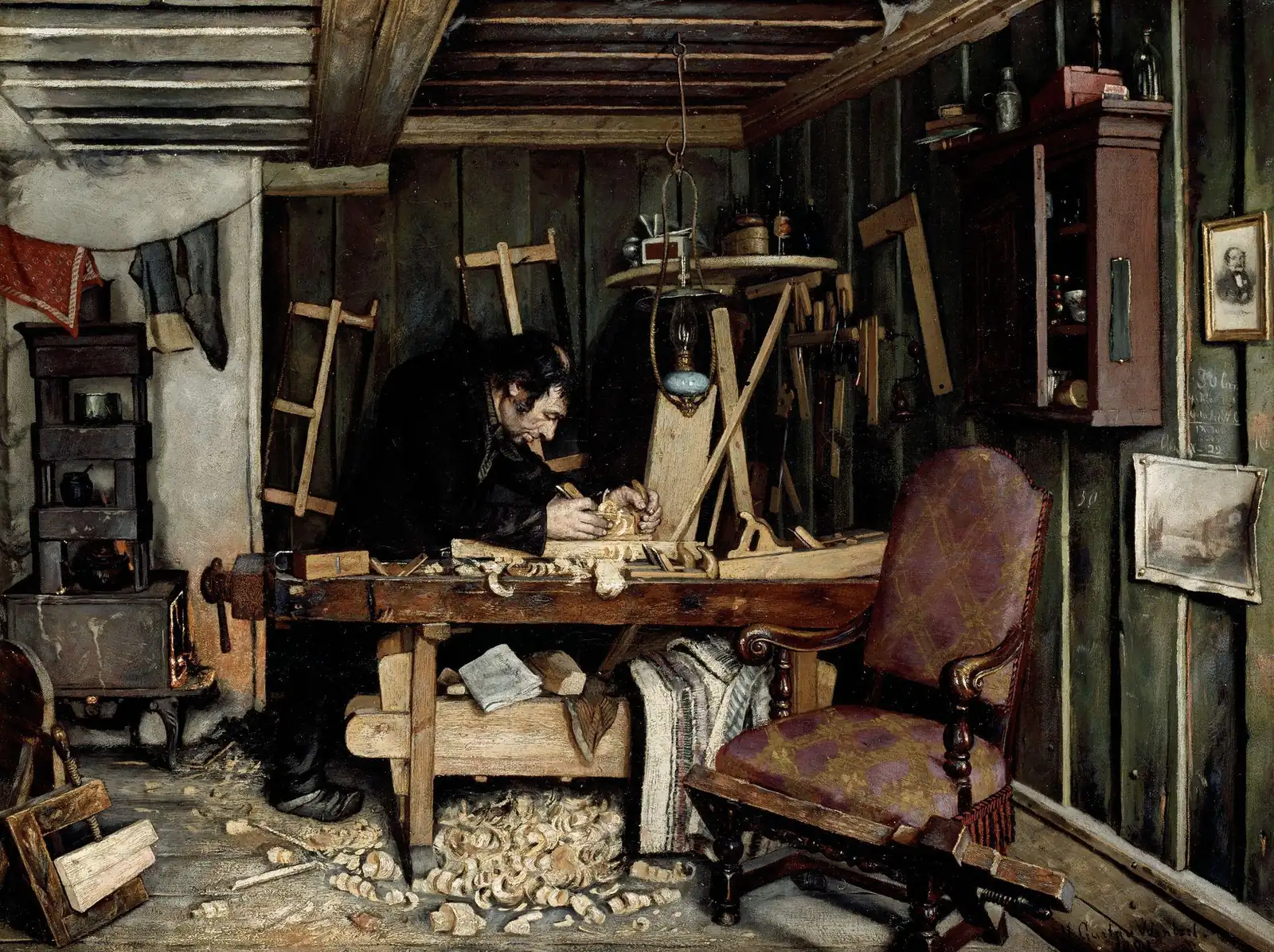
We have not reproduced any photograph of his work. His estate is recent and those images are not ours to use. The painting above is a Norwegian carpenter's shop from 1881, and the planes below are somebody else's.