
Hans Wegner designed more than five hundred chairs. Perhaps a hundred went into production and a dozen are still being made seventy years later, which is a strike rate no designer has any right to.
The reason is in his first job, not his last.
One. Cabinetmaker first, designer second.
He was born in 1914 in Tonder, in southern Denmark, the son of a shoemaker. He was apprenticed to a cabinetmaker called H. F. Stahlberg and qualified at seventeen.
That order matters more than anything else about him. He learned to build chairs before he learned to draw them, so when he began designing he was never proposing shapes and hoping somebody could make them. He already knew what a joint could take, how a curve behaves when it runs through a leg, and where a chair fails after ten years of people leaning back on two feet.
Look at how many people in this series arrived at the bench sideways. Castle from sculpture, Esherick from painting, Fredell from architecture, Krenov at thirty-seven. That route produces originality and it is genuinely valuable. Wegner is the counter-case, and the counter-case is worth stating plainly: a maker who designs will produce fewer bad ideas, because a great many bad ideas are eliminated by the hands before they reach the paper.
Two. He went looking, and found it in China.
His breakthrough came from studying Ming dynasty Chinese chairs.
In 1943 and 1944 he produced a series he called the China Chairs, drawn from that study. Out of that line came the Round Chair of 1949, the piece so widely admired that people simply call it The Chair.
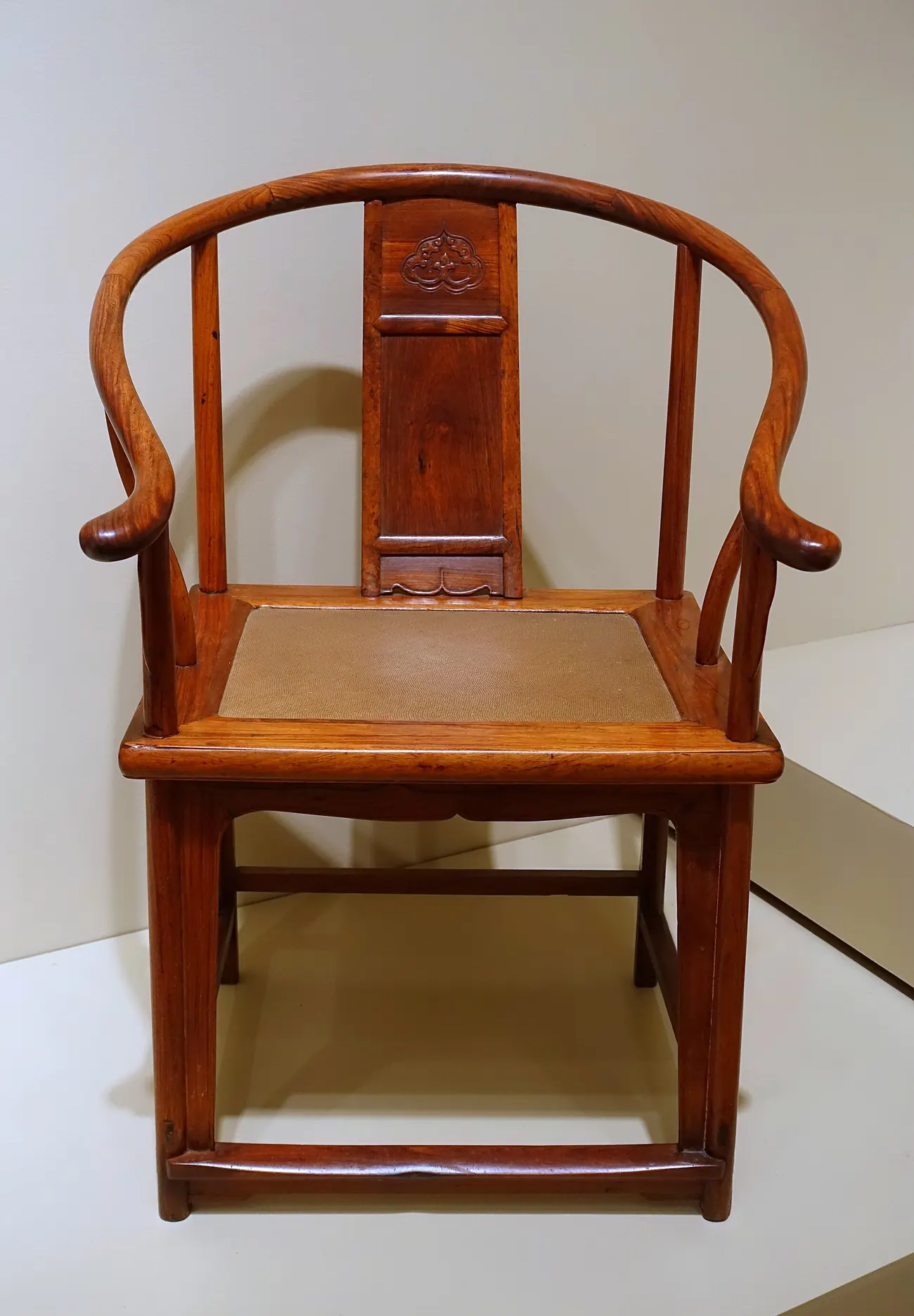
Look at the Ming original below. The curved crest rail sweeping round into the arms in one continuous line. The economy of members. The horseshoe back that is simultaneously the backrest, the armrest and the main structural element.
Look at what a Ming horseshoe-back armchair does: the curved crest rail sweeps round into the arms in one continuous line, so a single member is simultaneously the backrest, the armrest and the main structural element.
That single move, one member doing three jobs, is the whole vocabulary of what the world came to call Danish modern.
Which is worth saying carefully. The most celebrated Scandinavian chair of the twentieth century is a Danish cabinetmaker's response to Chinese furniture from three hundred years earlier. He did not hide it, he named the series after it. The lesson is not that he borrowed. It is that he went and studied a tradition properly instead of glancing at a photograph, exactly as Kristina Madsen did in Fiji in episode thirteen.
Three. Five hundred chairs.
The Wishbone chair, designed in 1950 for Carl Hansen and Son, is still in production and has been continuously since. Its seat is woven from paper cord, and weaving one takes a person around an hour.
But the number is the real lesson. Five hundred designs. Not five hundred masterpieces, five hundred attempts, of which most are forgotten and a handful are among the best chairs ever made.
That ratio is the normal shape of a creative life and almost nobody shows it to you. We see the Wishbone and the Round Chair. We do not see the four hundred and eighty that went nowhere. Judy Kensley McKie at episode eleven needed eleven years to find her voice. Wegner found his early and then spent fifty years generating volume, and the volume is what produced the hits.
He died in 2007, aged ninety-three.
What to carry forward
Learn to build it before you design it. The hands eliminate bad ideas cheaply, which is the whole argument for making before drawing.
One member, several jobs. When a piece feels cluttered, look for a part that could take over the work of two others. That is the Ming move and it never stops being useful.
Study the source, not the photograph. Both Wegner and Madsen went to a tradition properly. That is the difference between influence and pastiche.
Make five hundred of something. The successes come out of volume. Protecting yourself from failed attempts also protects you from the good ones.
A note on sources
His birth in Tonder in 1914 to a shoemaker, the apprenticeship with H. F. Stahlberg and qualifying at seventeen, the Wishbone chair of 1950 for Carl Hansen and Son, the Round Chair of 1949 and his death in 2007 are documented by Carl Hansen and Son, who still make the chair, and by the standard design literature. The China Chair series of 1943 to 1944 and its derivation from Ming furniture is well attested and was acknowledged by Wegner himself.
One story we have left out: the Round Chair is often said to have been used at the first Kennedy and Nixon television debate in 1960. It is repeated everywhere, but we could not find a photograph that clearly shows it, so we mention it here as a claim rather than treating it as fact.
His estate is live, so none of his work is reproduced. The chair above is Chinese and about three hundred years older than he is.