
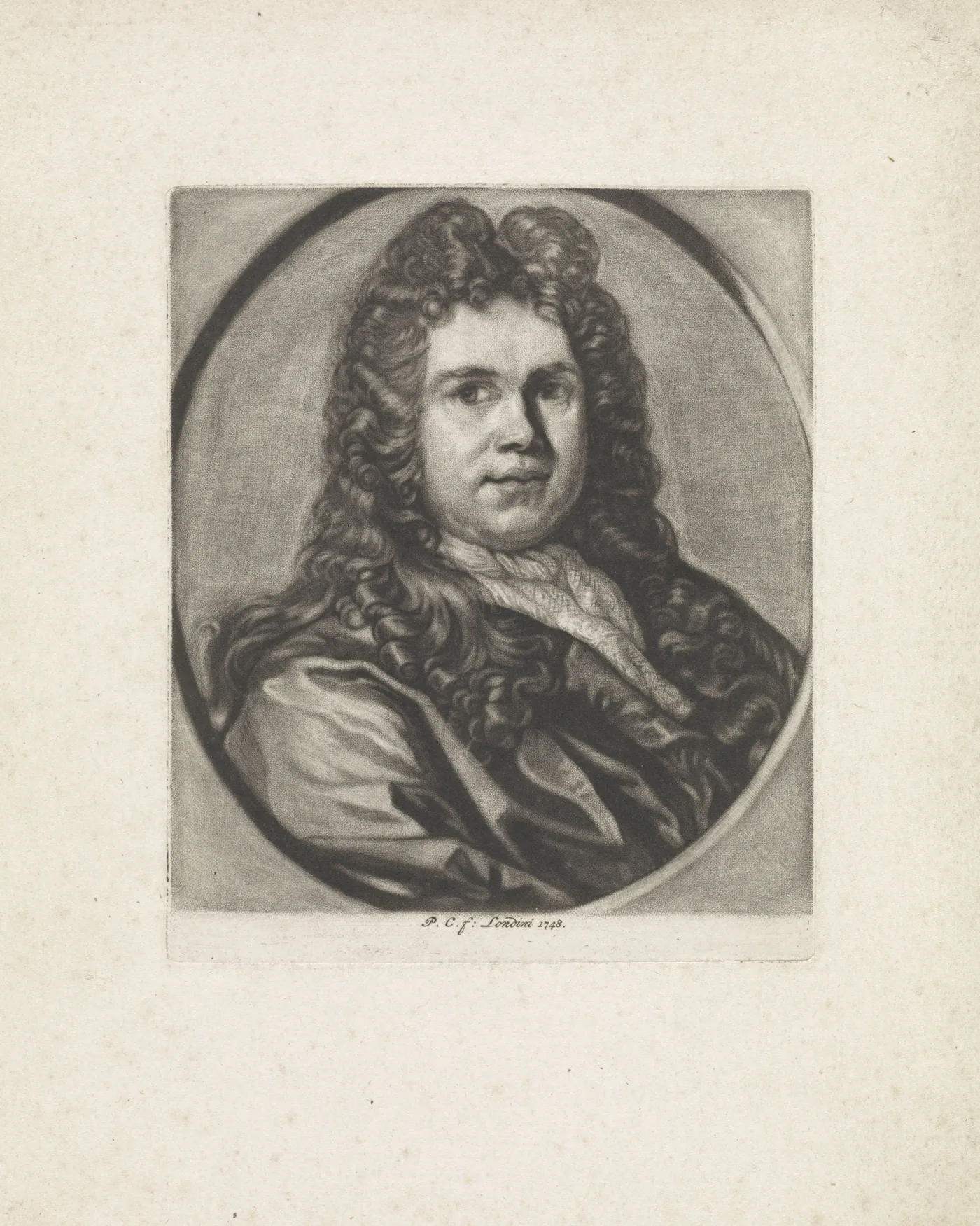
On a January evening in 1671, a gentleman out walking near Deptford looked through the window of a small, isolated cottage and saw a young man carving.
The gentleman was John Evelyn, the diarist, one of the best-connected men in England. The young man was twenty-two, unknown, and working alone on a copy in wood of Tintoretto's Crucifixion, a painting with more than a hundred figures in it, which he was rendering in relief, surrounded by a frame of carved flowers and fruit.
Evelyn could not believe what he was looking at. Within weeks he had introduced the young man to King Charles the Second, and to Christopher Wren, who was at that moment rebuilding London after the Great Fire.
That is how Grinling Gibbons was found. Everything after it followed from someone happening to glance through a window.
Who he was
Gibbons was born in Rotterdam in 1648, to English parents. His father was a draper with business in the Netherlands. He grew up in the Dutch world of still-life painting, where the whole point was to render a lemon peel or a dead pheasant so convincingly that you could feel the weight of it. He came to England around 1667, in his late teens, and worked in obscurity for several years.
After Evelyn found him, he never lacked work again. He carved for Wren at St Paul's Cathedral, where he made the choir stalls, the bishop's throne, and a great organ screen, along with most of the stone panels below the lower windows on the outside. He worked at Windsor, at Hampton Court, at Petworth, at Blenheim, and at Trinity College in Cambridge. In 1693 he was made master carver to the Crown. He died in 1721.
What he actually did
The work is difficult to describe to someone who has not stood in front of it, because the first reaction is usually disbelief that it is wood at all.
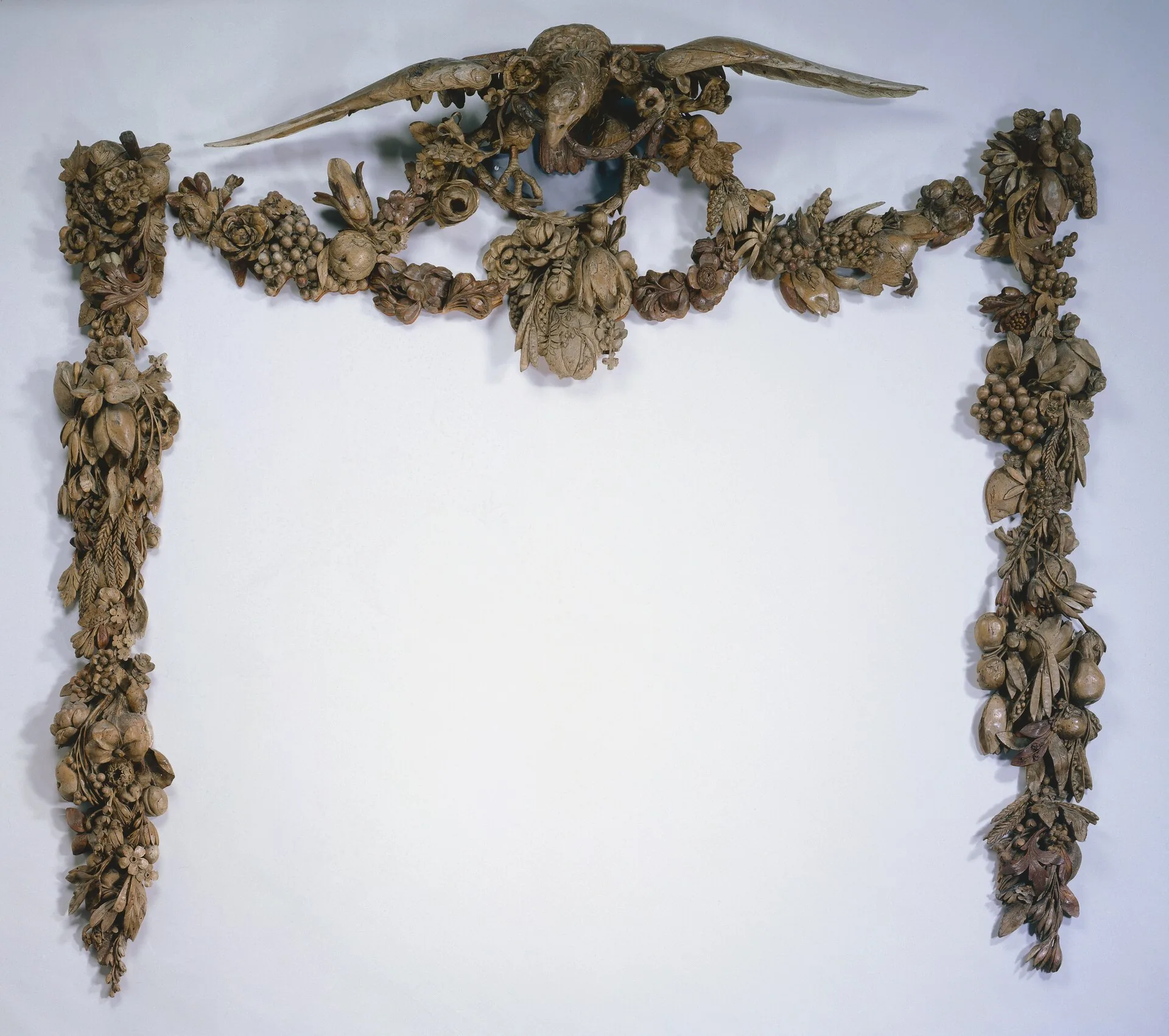
Gibbons carved cascades: great vertical drops of flowers, fruit, wheat, fish, game birds, shells, cherubs, musical instruments, piled and tangled together and hung down the sides of panelling and overmantels. They are not carved in relief in the ordinary sense. They are carved almost free of the wall, layer behind layer, with stems and petals cut so thin and so completely undercut that they stand clear in the air.
The famous claim about them is that they move. Walk past a Gibbons cascade at Petworth and the thinnest petals will tremble slightly in the air you displace. That is not a metaphor. He cut wood down to the thickness of paper and left it there.
He also carved, at least twice, a cravat, a neckcloth of Venetian needlepoint lace, rendered in wood, complete with every loop and knot of the lace, hanging as if just taken off. One is in the Victoria and Albert Museum. It is a piece of dead timber pretending to be the lightest fabric a person could own, and it is the clearest statement he ever made about what he thought wood could be made to do.
The wood is the point
He worked in limewood, which is the same tree Americans call basswood and Europeans call linden.
This is not an accident, and it is the single most useful thing in this story for anyone who makes things. Limewood is pale, soft, and, crucially, has almost no figure. The grain is fine, even, and nearly directionless. It has no dramatic stripes, no wild swirl, no character of its own to speak of.
Almost every other maker in this series chose wood for its beauty. Gibbons chose wood for its silence.
Because grain is a structural weakness as much as a decoration. Wood splits along it. Carve a petal one millimetre thick out of oak and it will snap along the ray. Carve the same petal out of lime and it holds, because there is no strong direction along which it wants to fail. The absence of figure is exactly what let him cut that thin.
He also did not use lime for structure. The panelling, the frames, the things that had to hold weight, were oak. Lime was for the parts that had to look alive. He used two woods for two jobs and never confused them.
What to carry forward
Choose the wood for the job, not for the photograph. This is almost the opposite of the lesson from Nakashima, and both are true. Nakashima chose a board because of what its figure said. Gibbons chose a board because it said nothing at all and would therefore do as it was told. The real principle underneath both of them is the same: know what you are asking the material to do before you choose it.
Undercut. Most beginner carving is timid: shallow, and still attached to the background everywhere. What makes Gibbons's work read as alive is that he cut behind things. A leaf that is genuinely separated from the surface behind it casts a real shadow, and that shadow is what makes the eye believe it. Shadow is a material, and undercutting is how you make it.
Thin is a decision, not an accident. He knew exactly how far he could go with lime, and he went right up to that line every time. That confidence comes from knowing one wood extremely well, not from being brave.
A myth worth correcting
You will read, in a great many places, that Gibbons signed his work with a carved peapod, open if he had been paid, closed if he had not.
It is a good story and it is not true. It was examined and dismissed by the scholar David Green in his study of Gibbons in 1963, and it has been repeated confidently ever since anyway. Peapods appear in his cascades because peapods appear in Dutch still-life painting, which is where his eye was trained. That is all.
It is worth knowing which parts of a story are true, especially when the false part is the most charming one.
A note on sources
Dates and career details here follow the Dictionary of National Biography entry, the Victoria and Albert Museum's material on Gibbons, and Britannica. The peapod correction is Green, 1963. If you want to understand the work, though, no reading substitutes for standing in front of a cascade and trying to work out where the wood stops.