
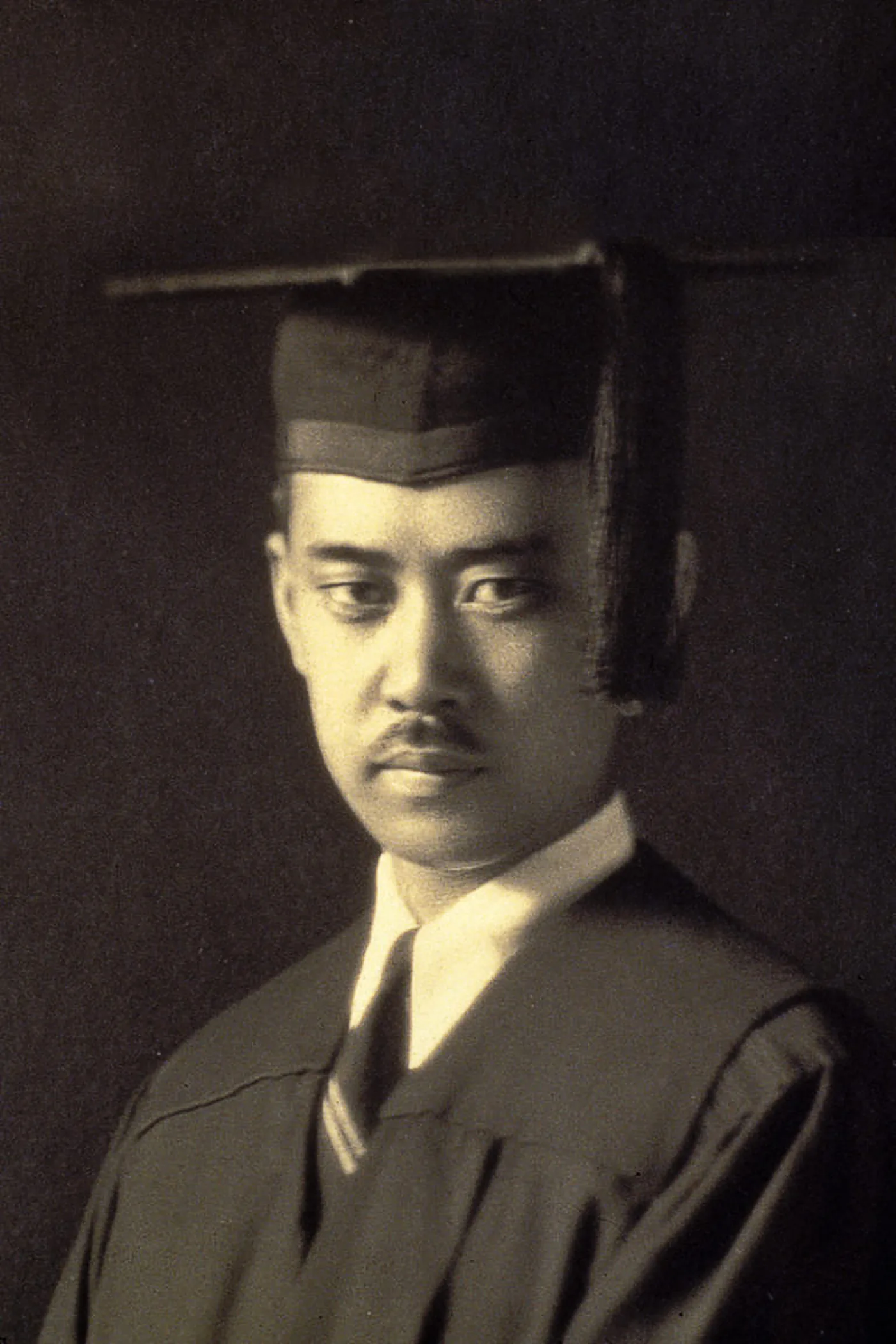
George Nakashima trained as an architect, travelled most of the way around the world, and did not become a woodworker in earnest until he was nearly forty. What turned him was the worst thing that ever happened to him.
He was born in Spokane, Washington, on 24 May 1905, the son of Japanese immigrants. He grew up hiking in the Olympic mountains, and that is where the reverence for trees starts. Not in a workshop, but outdoors, in front of living things far older than he was. He studied architecture, took a master's degree at MIT, and then did something unusual for a young American architect in the early 1930s. He sold what he owned, bought a steamship ticket, and left.
He worked in Paris. He went on to Tokyo and joined the studio of Antonin Raymond, an architect who had worked under Frank Lloyd Wright. Raymond sent him to Pondicherry in India to supervise construction of a dormitory at the Sri Aurobindo Ashram. He stayed for years, took a Sanskrit name, and worked on a building where the craftsmen finished concrete by hand. He returned to America in 1940 with a very different idea of what a building, or a chair, was for.
Then came Pearl Harbor, and Executive Order 9066.
In 1942 Nakashima, his wife Marion, and their infant daughter Mira were sent to Camp Minidoka at Hunt, Idaho, along with his extended family. It was a prison camp in the high desert, and there is no version of this story in which that was anything other than an injustice done to American citizens because of their ancestry. It should be said plainly, because the furniture that came afterwards is often admired by people who have never been told where the training came from.
Here is where it came from.
Inside the camp Nakashima met a man named Gentaro Hikogawa, who had been trained in Japan as a carpenter. Hikogawa taught him traditional Japanese joinery: the tools, the sharpening, the discipline, and above all the patience: the habit of working to a standard that has nothing to do with whether anyone is watching or paying. Nakashima had spent a decade around architecture. In a barracks in Idaho, with almost nothing to work with, he learned the craft.
The family was released in 1943, sponsored by Antonin Raymond, who brought them to his farm in New Hope, Pennsylvania. In 1946 Nakashima set up his own workshop on Aquetong Road. He spent the next forty-four years there, and the studio is still there today, run by Mira, the daughter who was a baby in the camp.
What he actually believed
Nakashima's idea can be put in one sentence: a tree that has been cut has a right to a second life, and the woodworker's job is to find the single best use for that particular board.
That sounds like sentiment. In practice it is a working method, and a demanding one. It meant he bought whole logs and enormous slabs, air-dried them for years, and kept a vast inventory, then waited for the right commission to come along for a specific board, rather than cutting whatever board was nearest to fit whatever order came in. The wood was chosen first. The piece followed.
It also meant he refused to hide what the wood was. Where most furniture of his era squared everything off, Nakashima left the free edge, the natural outer edge of the tree, as the visible edge of the tabletop. Where a slab had split, he did not fill the split or reject the board. He cut a butterfly key, a bowtie-shaped inlay let into the surface across the crack, which mechanically stops the split from spreading and, being usually a darker wood, announces itself.
That butterfly joint is the whole philosophy in one detail. It is a repair. It is structural, it genuinely works, and he made no attempt whatsoever to disguise it. The flaw stays visible and the fix is beautiful. Most of what people love about his tables is that decision.
He also disliked being called an artist. He called himself a woodworker. He wrote a book late in life called The Soul of a Tree, and toward the end he began making Altars for Peace, large slab tables intended to be given to each continent, the first of which went to the Cathedral of St John the Divine in New York. He died in 1990.
What to carry forward
Choose the board before the design. Most of us do the reverse. We decide what we want to make and then look for material that will not fight us. Nakashima's order is harder and produces better work, because it forces the piece to answer to something real instead of to a sketch.
Do not hide the flaw. Fix it in a way that holds, and let the fix show. A knot, a check, a colour change: these are the evidence that the thing was alive and that a person dealt with it. The instinct to sand history out of a board is worth resisting.
Buy wood before you need it. He air-dried for years. Most of the problems that ruin a piece months later were decided by moisture long before the first cut.
And the uncomfortable one: he learned the most important skill of his life in the worst year of it, from someone who had no reason to teach him and nothing to gain by it. Craft moves between people that way far more often than it moves through schools.
A note on sources
Details of Nakashima's life are widely repeated online and not always accurately. The dates here follow the Densho Encyclopedia's record of the internment years and the Nakashima Woodworkers studio history. If you are researching him seriously, start with those, and with his own book.