
George Hepplewhite died in June 1786.
The Cabinet-Maker and Upholsterer's Guide, the book that put his name on a century of furniture and on every auction catalogue since, was published in 1788.
Somebody else finished it and got it out. Her name was Alice Hepplewhite, and she is the reason you have heard of her husband.
One. What the book did.
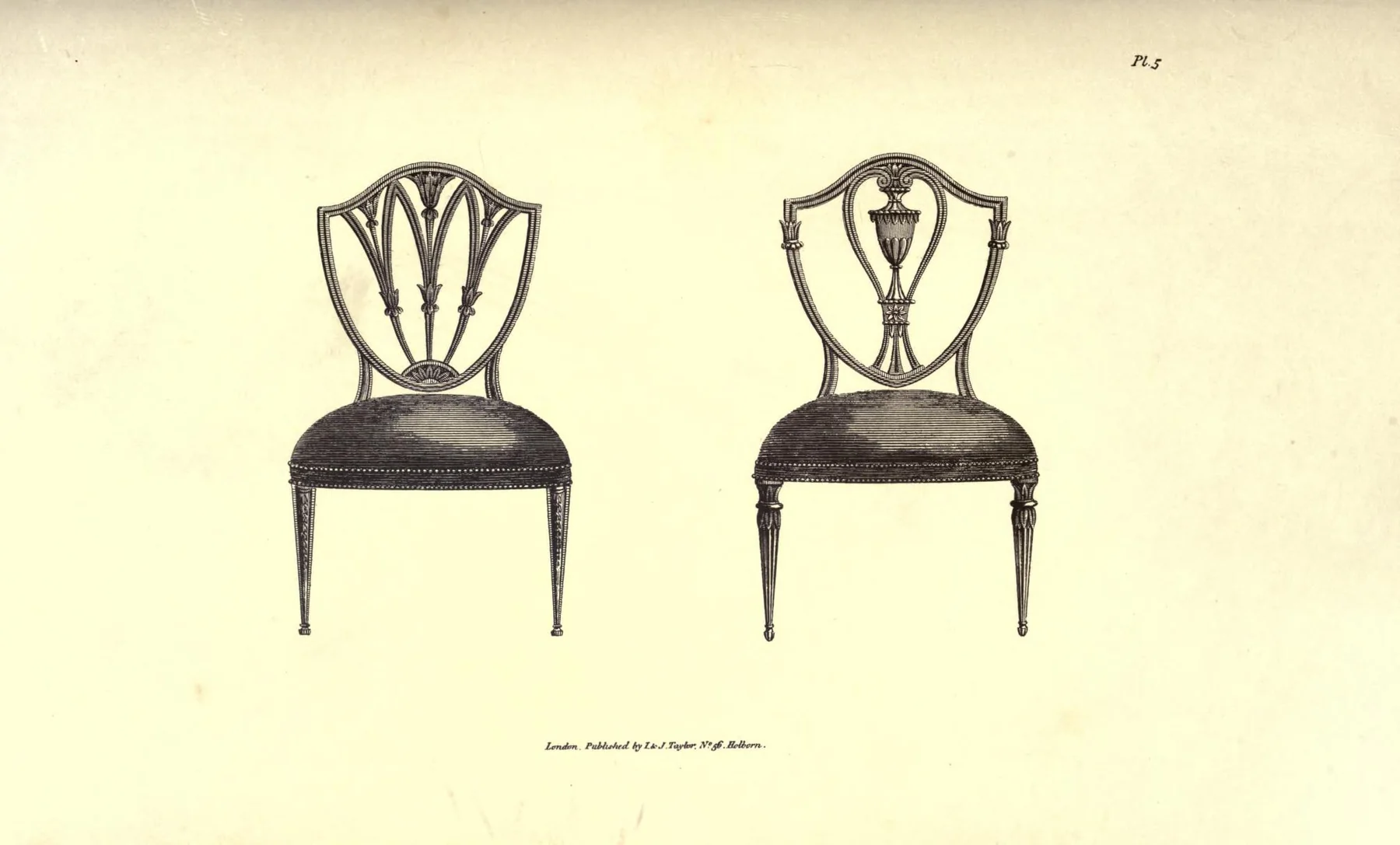
Look at the plate. Two chairs, both with the shield back that the name now means: a curved shield-shaped frame carried clear of the seat on two uprights, with a splat inside it. One splat is a plume of feathers, the other an urn. The legs are square, tapered, and light.
That form is everywhere in English and American furniture of the 1790s, and the Guide is why. Nearly three hundred designs across a hundred and twenty-odd plates, covering chairs, sideboards, beds, tables, and the fittings of an entire house.
It went to a second edition in 1789 and a revised third in 1794. American makers worked from it directly.
And as with Sheraton, not one surviving piece of furniture can be documented to Hepplewhite's own workshop.
Two. Alice.
He had a shop in Cripplegate in London. He is said to have served his apprenticeship with Gillows of Lancaster, though that is repeated more confidently than the evidence supports.
When he died, his widow Alice took over the business and ran it under the name A. Hepplewhite and Co. That is the name on the title page of the Guide. She assembled it, financed it, and published it two years after his death, and then published two further editions.
Think about what that took in 1788. A widow running a cabinetmaking firm, deciding that the most valuable asset in the workshop was a pile of her husband's drawings, and turning it into the most influential furniture book of the decade.
The series has been keeping a list of the people who get left out of these stories. Niels Vodder, who built what Finn Juhl drew. Otto Korhonen and Aino Marsio, without whom Aalto has no bent plywood and no company. Alice Hepplewhite belongs on it, and her case is the starkest, because the name she was publishing under was his.
Three. Why the book was good.
The Guide was not aimed at aristocrats. Its preface says roughly that the intention is to unite elegance with utility, and to be useful to the trade as well as agreeable to the gentleman.
That is a commercial position, and it is the right one. The designs are simpler to build than Chippendale's rococo. The ornament is inlay and painted decoration rather than deep carving, which does not need a specialist carver on the payroll. The forms are light, which uses less timber.
A provincial cabinetmaker with two apprentices could open the Guide and produce something fashionable. That is the whole reason the shield back turns up in market towns and in Philadelphia and not just in London.
Cheap to make, light on material, no rare skills required, and it looks expensive. That is a design brief, and the Guide answered it better than any book of its generation.
What to carry forward
Your drawings are an asset. Alice Hepplewhite understood that a folder of designs had more value than the workbenches. If you were gone tomorrow, is there anything in your workshop somebody could publish?
Design for the shop that will build it. Inlay instead of carving, light sections instead of heavy, simple curves instead of compound ones. He was designing for other people's workshops and their limits, and that is why it spread.
Elegance and utility, stated together. It was on his title page in 1788 and it is still the whole argument. Neither one on its own sells anything.
Name the person who finished it. In this case the whole legacy is posthumous. Somebody always does that work and it is almost never the person on the cover.
A note on sources
His death in June 1786, the Cripplegate premises, the publication of The Cabinet-Maker and Upholsterer's Guide in 1788 under the name A. Hepplewhite and Co. by his widow Alice, the second edition of 1789 and the revised third of 1794, the roughly three hundred designs, and the absence of any documented surviving furniture from his own hand are recorded by the Victoria and Albert Museum and the standard scholarship.
Two things are commonly stated with more confidence than the record supports, so we are flagging rather than repeating them: his year of birth, sometimes given as around 1727, and the apprenticeship with Gillows of Lancaster. Both may be true and neither is firmly established.
He died in 1786, so the plate above is long out of copyright.