
Everyone else in this series came to furniture from art, from a trade, or from nothing at all.
Gail Fredell came from a building site.
She took a degree in architecture at the University of California, Berkeley, in 1974. Then she spent four years working as a general contractor, which is to say actually putting up buildings, running the work, and dealing with structure at full size and full consequence. Only then did she go back to school, taking an MFA in woodworking and furniture design at the Rochester Institute of Technology in 1980.
One. Full scale first, then furniture.
Four years of contracting is an unusual thing to find in a furniture maker's biography, and it explains most of what her work looks like.
Her forms are minimal and architectural. She works in wood, but also in steel, concrete, stone and cast glass, and moves between them without ceremony. That is what happens when your first professional experience of making is a building rather than an object: you learn early that material is chosen for what the structure needs, and that no material has a claim on your loyalty.
The RIT date is worth noticing. Wendy Maruyama, from episode ten, took her MFA in that same programme in that same year. Two of the five makers in this block came out of one room at one moment, at the point where American furniture education was just becoming a serious thing.
She is also, like Somerson in the previous episode, one of a group of women who from the late 1970s onward simply set up and ran their own studio furniture businesses. Not as a statement. As a living.
Two. The provocation, for a series about wood.
Thirteen episodes of this series have been about people devoted to timber. Nakashima waiting years for the right board. Krenov keeping a plank until he knew what it wanted to be. Madsen cutting patterns into a surface.
Fredell is the useful counterweight, because for her wood is one material among several.
Concrete in studio furniture. Cast glass. Steel. Stone. These are not accents bolted onto a wooden piece, they are structural choices made on the same terms a wooden one would be.
That is worth sitting with if you make things out of one material, which most of us do. Material loyalty feels like commitment and often is. But it is also a habit, and habits make decisions for you before you have noticed a decision was available. The question a piece actually asks is what it needs, and sometimes the honest answer is not the thing you have a rack full of.
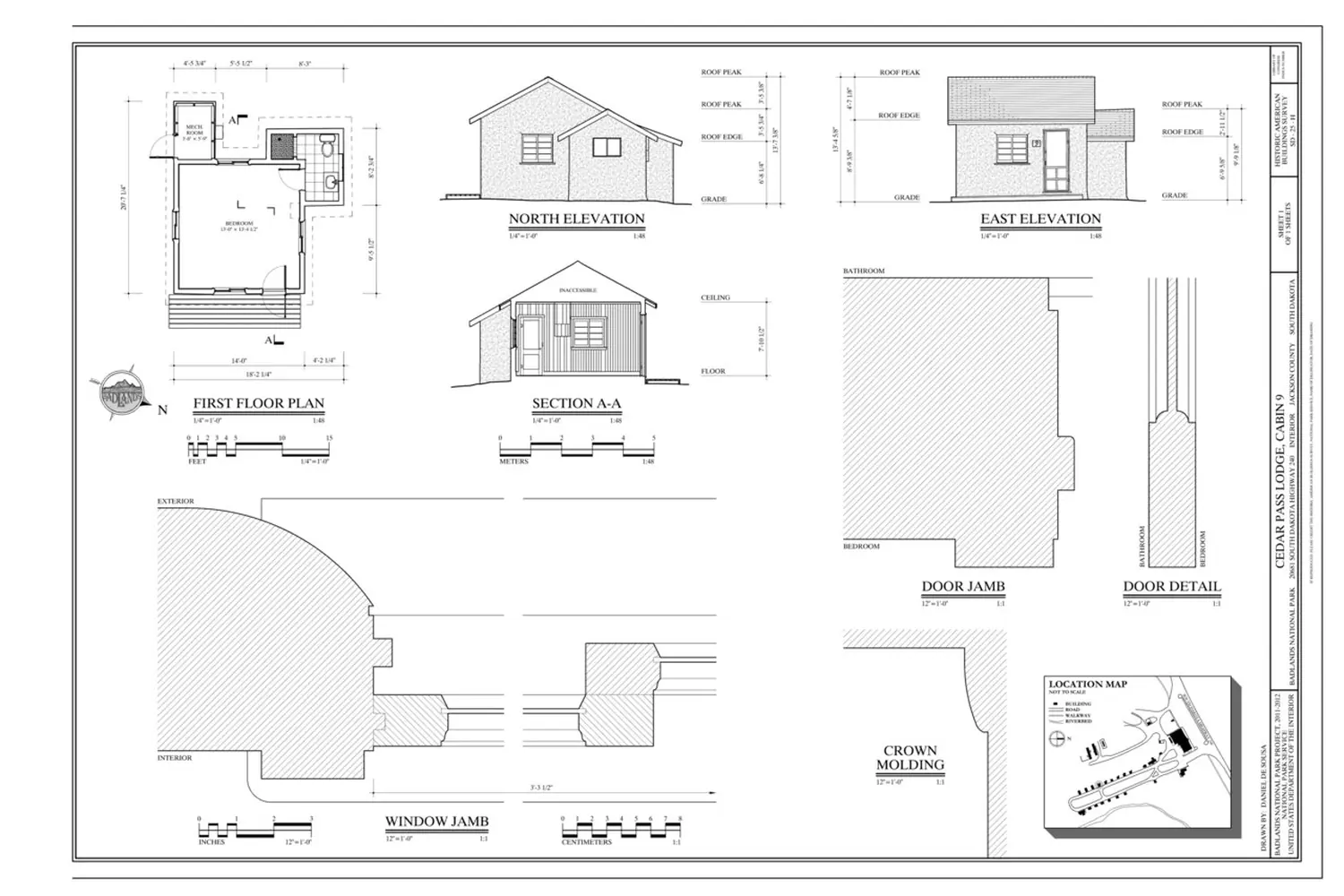
Picture a measured drawing sheet: building elevations and full-scale joinery details, drawn by the same hand at wildly different scales. That seam between architecture and cabinetmaking is exactly where her work sits, and almost nobody occupies it, because the training rarely goes both ways.
Look at that sheet. Building elevations and joinery details, drawn at the same time by the same hand, at two wildly different scales. That seam between architecture and cabinetmaking is exactly where her work sits, and almost nobody occupies it, because the training almost never goes both ways.
Three. Furniture for rooms that are not living rooms.
Her work is held by the San Francisco Museum of Modern Art, the Oakland Museum and the Fuller Craft Museum, which is the expected list.
Two other places on it are not expected. Stanford University's Memorial Chapel. And the AIDS Memorial Grove in Golden Gate Park.
Those are not domestic commissions and they are not gallery pieces. They are objects made for spaces where people go to grieve, to mark something, to sit with a thing that cannot be fixed. Furniture in that setting has a job most furniture never has to do.
It also connects directly to Pye at episode eight and Somerson at episode twelve. Somerson's argument was that utility is how the feeling gets in, because furniture reaches people repeatedly and unguarded. A bench in a memorial grove is that argument at its furthest extent: the entire purpose of the object is to hold somebody while they feel something.
From 1993 to 2001 she directed the furniture programme at the Anderson Ranch Arts Center near Aspen, and since 2012 she has taught in the Foundation Studies and Furniture Design departments at RISD. Her studio is at Smokestack Studios in Fall River, Massachusetts.
What to carry forward
Build something at full scale once. A shed, a deck, a wall. Structure behaves differently when it is large enough to hurt you, and that knowledge comes back down into small work.
Check whether your material is a decision or a habit. If every piece you make is in the same timber, it is worth asking once per project whether that was chosen or merely defaulted to.
Aim at a room that is not a living room. Chapels, waiting rooms, memorial spaces, libraries. The brief is harder and the work matters more.
Running the programme counts. Anderson Ranch for eight years, RISD since 2012. This series keeps turning up people whose largest contribution was building the place where other people learned.
A note on sources
The Berkeley architecture degree of 1974, the four years of contracting, the 1980 RIT MFA, the Anderson Ranch directorship from 1993 to 2001 and the RISD teaching from 2012 follow her own published biography and the Furniture Society's directory. The collections list, including Stanford Memorial Chapel and the AIDS Memorial Grove, comes from the same sources and from Dedee Shattuck Gallery, which represents her.
She is alive and working, so nothing of hers is reproduced here. The drawing above is a Historic American Buildings Survey sheet, made by the U.S. National Park Service.
That completes the second block: five makers, all women, spanning apprenticeship, art school, cooperative workshop, architecture and a Fulbright to Fiji. Between them they built two university departments, ran an arts centre, led a college, and made 120,000 paper tags by hand.