
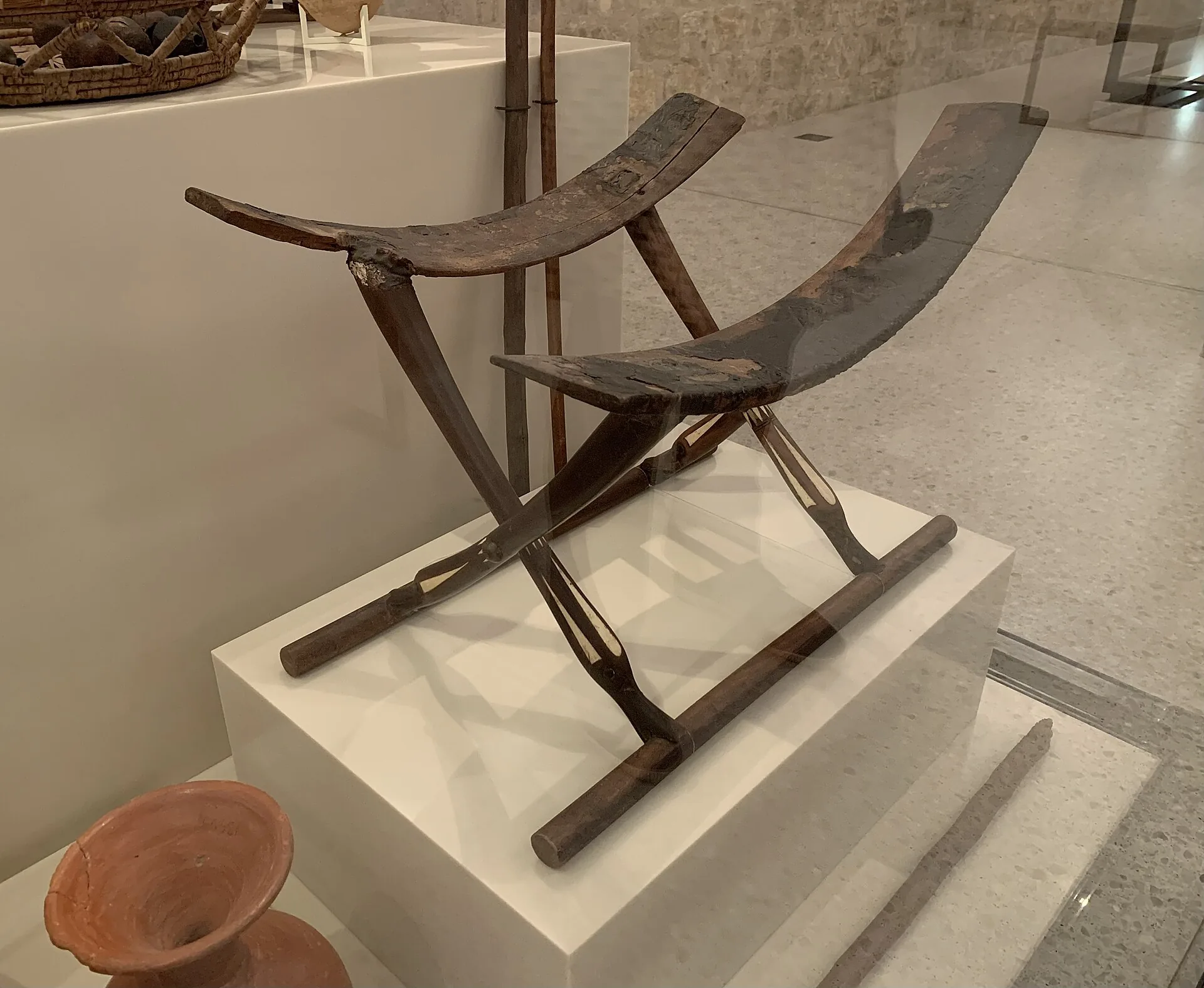
Three episodes ago we made the case for Hans Wegner: learn to build it before you design it, because the hands throw out bad ideas cheaply.
Finn Juhl is the argument against.
He never trained as a cabinetmaker. He could not have built one of his own chairs. And he produced the most original Danish furniture of his generation, which the Danish furniture establishment disliked intensely for about fifteen years before deciding he had been right.
One. He wanted to be an art historian.
He was born in 1912 in Frederiksberg, just outside Copenhagen. He wanted to study art history. His father refused, so he went to the Royal Danish Academy of Fine Arts to study architecture instead, under Kay Fisker, and left without finishing his degree.
From 1934 he worked in Vilhelm Lauritzen's office for about eleven years, on the Danish Broadcasting House and the terminal at Copenhagen Airport. Furniture was the thing he did in the evenings.
Hold that against the roster so far. Krenov came to the bench at thirty-seven, Castle from sculpture, Esherick from painting, Fredell from architecture. Juhl is one more, and by now the pattern is too consistent to be an accident. The people who change the shape of an object are very often the ones who were not taught what its shape is supposed to be.
Two. He took the seat off the frame.
Danish furniture in the 1930s was Kaare Klint's furniture: measured, proportioned, derived from historical types, structurally frank. Nothing was hidden and nothing floated.
Juhl separated the two halves of a chair. The seat and the back became shells, shaped like something carved, and they sat clear of the supporting frame instead of growing out of it. You can see daylight where you expect a joint. The frame holds; the shells receive the body; neither pretends to be the other.
Look at the stool above. It is Egyptian, roughly three and a half thousand years old, and it does the same thing: a curved seat slab lying across an X-frame, held but not absorbed. Duck heads at the ends, ivory in the legs. The idea Juhl was attacked for in 1940 was not new. It was simply not what Denmark had been doing.
He worked from 1937 with a master cabinetmaker called Niels Vodder, who could actually make what Juhl drew, and they showed together at the Copenhagen Cabinetmakers' Guild exhibitions. That pairing is the whole story. Juhl supplied a shape nobody at a bench would have arrived at. Vodder supplied the ability to build it. Neither half works alone.
The critics were unkind. The rational school thought the work was sculpture pretending to be furniture, and expensive sculpture at that. He kept going.
Three. Then America noticed.
By the early 1950s Juhl was the Danish designer Americans had heard of. He designed for Baker Furniture in Michigan, he laid out Danish exhibitions in the United States, and in 1951 he designed the Trusteeship Council Chamber at the United Nations headquarters in New York, which opened the following year.
That is the room where the point lands. A man with no cabinetmaking certificate and an unfinished architecture degree designed a chamber of the United Nations, and the reason he got it was that his furniture looked like nothing else.
He died in 1989. The house he built for himself in Ordrup in 1942, and filled with his own furniture and his collection of modern Danish art, is now a museum you can walk through.
What to carry forward
Two parts, two jobs. If a chair fights you, try separating what holds the weight from what touches the body, and let the two be different shapes. Wegner's Ming move was one member doing three jobs. This is the opposite move, and both are correct.
Find your Niels Vodder, or be one. Almost nothing interesting gets made by a person who can both imagine it and build it. Most of it gets made by two people who trust each other.
Not knowing the rules is worth something, but only for a while. Juhl's advantage was that nobody had taught him what a chair frame is. That advantage expires. What he did with it, over fifty years, is the actual work.
A bad reception is data, not a verdict. He was written off for over a decade by the people who ran his own field. He was still right.
A note on sources
His birth in 1912, the architecture training under Kay Fisker at the Royal Danish Academy, the years in Vilhelm Lauritzen's office, the collaboration with cabinetmaker Niels Vodder from 1937, the Guild exhibitions, the work for Baker Furniture, the Trusteeship Council Chamber at the United Nations completed in 1952, his death in 1989 and the Ordrup house museum are all documented by the Finn Juhl house, by the manufacturers who still produce his designs, and by the standard literature on Danish modern.
One story we have left out of the body: the Chieftain Chair of 1949 is usually said to have got its name when King Frederik IX sat in it at the Guild exhibition. It is repeated everywhere and it may well be true, but we have not seen a first-hand source, so we are flagging it rather than telling it.
His estate is live and his designs are still in production, so none of his work is reproduced here.