
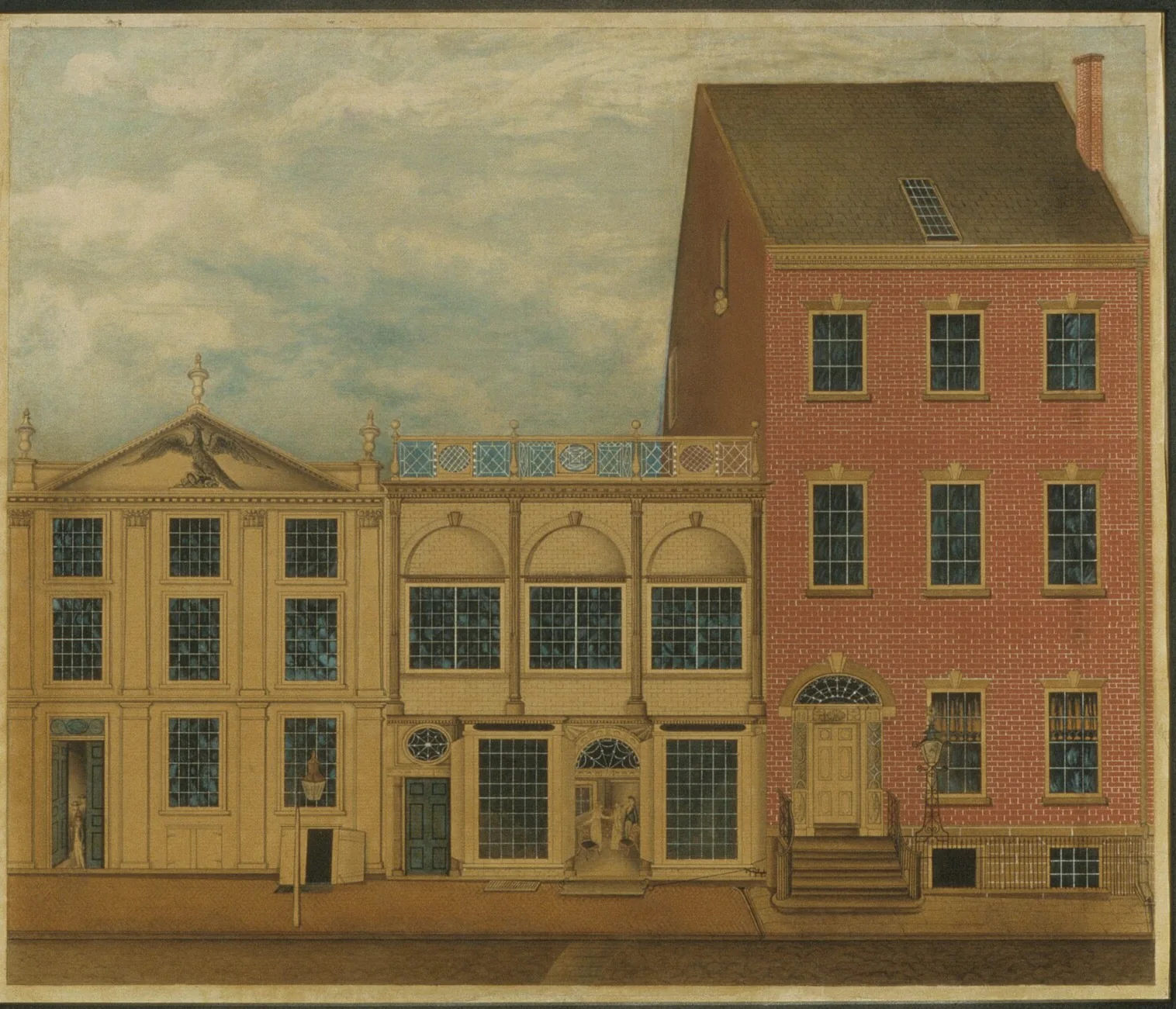
Three episodes in a row now have made the same argument: Chippendale, Sheraton and Hepplewhite are famous because of books.
Duncan Phyfe never published anything.
He got a style named after him anyway, he employed around a hundred people doing it, and unlike every writer in this block he died rich. It is worth understanding exactly how, because it is not the answer you expect.
One. The premises were the advertisement.
The picture above is his shop, warehouse and workshop at 168 to 172 Fulton Street in New York, painted around 1816. Three buildings. A showroom with arched windows and plate glass. A pediment with an eagle. Through the open door you can see figures inside.
That is the whole strategy in one image. Chippendale reached provincial makers through a book; Phyfe reached wealthy New Yorkers by occupying a block of Manhattan and making it look like a bank.
He was born in Scotland in 1770 and came to Albany with his family as a teenager in 1784. He trained there, moved to New York around 1792, and anglicised the family name from Fife to Phyfe a year or two later. By the 1810s he was running one of the largest furniture businesses in America, selling to the Astors and the Livingstons and shipping crated furniture down the coast to southern buyers who had never set foot in the shop.
Two. He changed style four times and never lost the customer.
This is the part that actually matters.
Phyfe worked for over fifty years. He started in the light neoclassical manner of the Federal period, moved through English Regency, then into the heavier American Empire style, and finished in the 1830s and 1840s making the plain broad-surfaced Grecian furniture that has almost no ornament at all.
Those are not small adjustments. The last work looks like it came from a different century than the first, and the same man made both.
Most makers in this series are remembered for one idea. Phyfe is the case for the opposite discipline: he stayed in business for half a century by watching what people wanted and building that, at a consistently high standard, without deciding at any point that his taste was more important than the order.
He retired in 1847, auctioned his stock, and died in 1854 leaving a fortune.
Three. The name outran the man.
Here is the sting.
Phyfe rarely labelled his work. Very little of what is sold as Duncan Phyfe has anything to do with him, and the label was applied loosely to a great deal of New York furniture from the period, much of it made by competitors of equal skill whose names nobody wrote down.
And his fame is largely posthumous. He was locally famous in his lifetime, but the elevation of Duncan Phyfe into a household style name happened in the early twentieth century, driven by collectors, dealers and a major museum exhibition, roughly seventy years after he stopped working.
So the pattern holds after all. Chippendale, Sheraton and Hepplewhite were made famous by documents they produced themselves. Phyfe was made famous by documents other people produced about him, seventy years late, and with much less accuracy.
The record decides. The only question is whether you write it or somebody else does.
What to carry forward
The premises are a claim. What a workshop looks like from the street is doing the same job a catalogue does, and Phyfe spent accordingly.
Follow the customer for fifty years. Four style changes, one business. Reinventing what you make is not a loss of integrity, it is how a workshop outlives a fashion.
Label the work. He did not, and the result is that most of what carries his name is not his and most of what is his carries nobody's. Sign and date it, and keep the book.
If you do not write the record, someone will write it later and get it wrong. That is the whole lesson of this block, and Phyfe is the proof by counter-example.
A note on sources
His birth in Scotland in 1770, the family's emigration to Albany in 1784, the move to New York in the early 1790s and the change of name from Fife, the Fulton Street premises, the scale of the business and its wealthy clientele, the progression through Federal, Regency, Empire and the later plain Grecian style, his retirement in 1847 and death in 1854 are documented by the Metropolitan Museum of Art, which holds both the watercolour above and a large collection of the furniture, and by the standard American decorative-arts scholarship.
The watercolour is attributed to John Rubens Smith and dated about 1816 by the Metropolitan Museum.
The looseness of Duncan Phyfe as an attribution, and the twentieth-century collector-driven revival of his reputation, are also the museum's account, not ours.
He died in 1854, so the work is long out of copyright.