
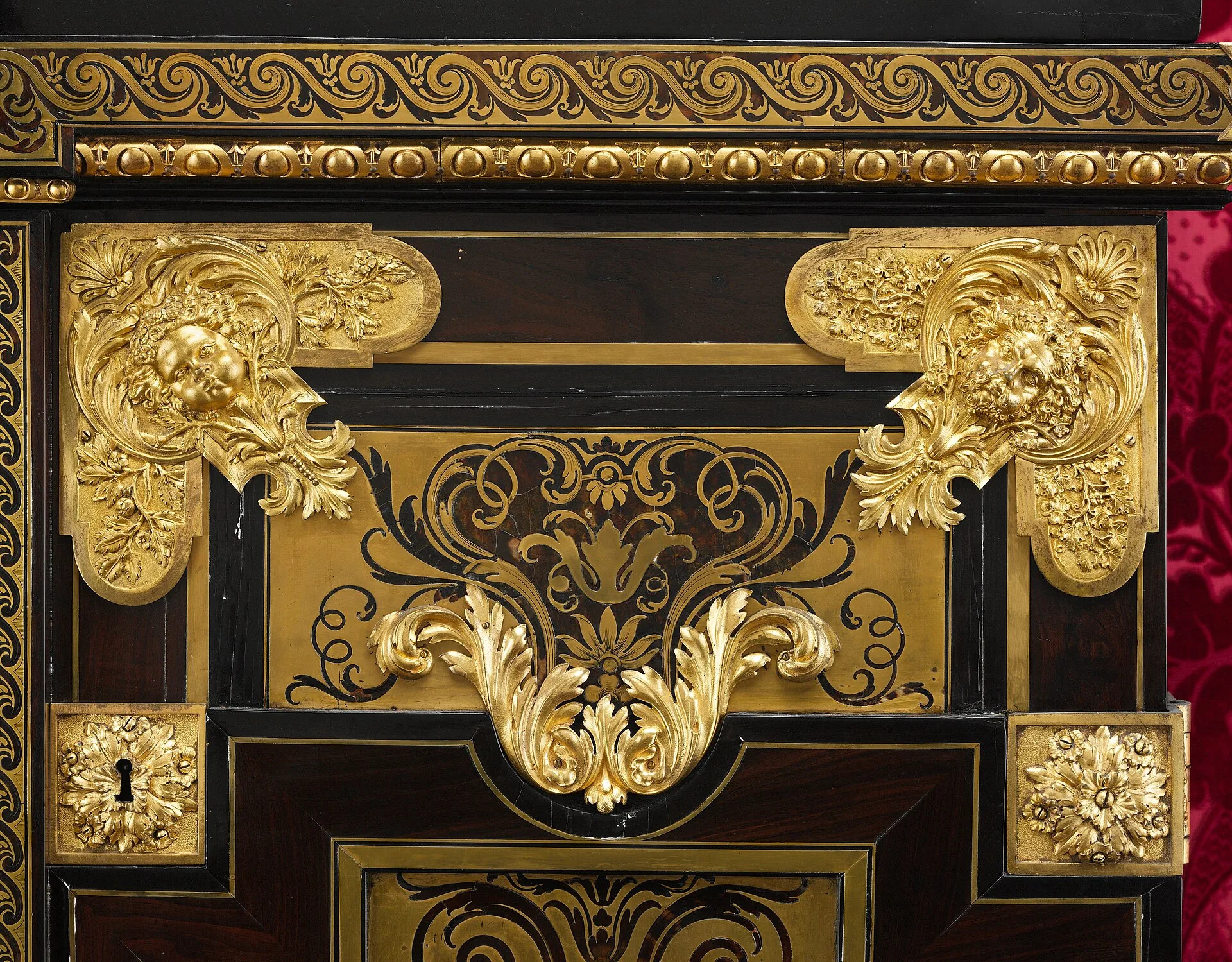
Look at the panel above. The pale scrollwork is brass. The dark ground it sits in is tortoiseshell. Every line of the pattern is a saw cut, and both halves came out of the same cut at the same moment.
That is the idea Andre-Charles Boulle is remembered for, and it is the most elegant piece of workshop thinking anywhere in this series.
One. How the trick works.
Take a sheet of brass and a sheet of tortoiseshell. Glue them together into a sandwich, with paper between so they can be separated later. Draw the pattern on the top. Then cut the whole sandwich at once with a very fine saw, following the line.
When you take the sandwich apart you have two complete sets of parts. Brass motifs and brass ground. Shell motifs and shell ground. Swap them, and you get two finished panels: the brass pattern laid into the shell ground, and the shell pattern laid into the brass ground.
The French called the first one premiere-partie and the second contre-partie. Boulle sold them as pairs, one commode with the light pattern and its twin with the dark.
Nothing is left over. The waste from one panel is the entire substance of the other. Every offcut has already been designed into a job.
There is a version of this available to anybody with a scroll saw or a fretsaw and two contrasting veneers, and it costs nothing but the paper between the sheets.
Two. The king took him out of the guild system.
He was born in Paris in 1642. In 1672, on Colbert's recommendation, Louis XIV granted him lodgings and a workshop in the Galeries du Louvre and the title of cabinetmaker, chaser, gilder and sculptor to the King.
That was not just an honour. Living in the Louvre put him outside the Paris guilds, and the guilds are the point. Guild rules kept trades apart: a man who worked wood was not supposed to work metal, and a man who cast bronze was not supposed to make furniture.
Boulle did all of it in one shop. That is why his work looks the way it does, with the gilt bronze mounts, the marquetry and the carcase all designed together instead of subcontracted and bolted on afterwards. The most copied furniture style in Europe came out of a legal exemption from the rule that a maker must stay in his lane.
Three. It nearly destroyed him.
He was a compulsive collector. He spent enormous sums on drawings and prints, on Raphael and Rubens, on anything he could get, and he was in debt for most of his adult life. Creditors pursued him for decades, and the King's protection is a large part of why they never took the workshop.
Then in 1720 his workshop burned. He was seventy-eight. The fire took his collection, his tools, his stock, and work belonging to clients that he still owed them.
He carried on. He died in 1732, at eighty-nine, and four of his sons kept the business going.
Two things follow from that life. He never stamped most of his work, so attributing it is genuinely difficult and always has been. And the technique was copied so thoroughly, for so long, that the phrase Boulle work now describes a method rather than a man.
What to carry forward
Design the waste into the job. The two-part cut is the purest example there is: the offcut is the product. Before you cut anything expensive, ask what the negative becomes.
Glue the sandwich, cut once. Two contrasting veneers, paper between, one saw line. It is a Saturday afternoon technique that produces a pair of panels that look like they took a month.
Cross the trades on purpose. Boulle's whole advantage was doing metal and wood in one room when the rules said not to. Look at where your own work stops and somebody else's begins, and ask who decided that.
Do not let the collection eat the workshop. He bought better than he sold for sixty years. The tools and the stock are the business. Everything else is a hobby with an invoice.
A note on sources
His birth in Paris in 1642, the grant of lodgings in the Galeries du Louvre in 1672 with the royal appointment, the technique of cutting premiere-partie and contre-partie from a single glued stack, his long-running debts and collecting, the workshop fire of 1720 and his death in 1732 are documented by the Metropolitan Museum of Art, the Wallace Collection, the Louvre and the Getty, all of which hold and publish on his work.
Because he seldom signed, a great deal of furniture called Boulle was made by his workshop, his sons, or by later makers in the nineteenth-century revival. The cabinet above is catalogued by the Metropolitan Museum as his.
He died in 1732, so the work is long out of copyright, which is why this page can show it.