
In 1929 Alvar Aalto won a competition to build a tuberculosis sanatorium at Paimio, in south-west Finland. He was thirty-one.
There was no cure for tuberculosis then. Treatment was rest, clean air and time, which meant patients lay in that building for months and sometimes years. Aalto designed the building, and then he designed almost everything inside it: the beds, the washbasins that ran quietly so as not to wake the next patient, the door handles, the light fittings, and a chair.
That chair is the reason he is in this series.
One. The brief was a body that could not breathe.
The Paimio Chair, from 1932, is a loop of laminated birch carrying a single sheet of bent plywood that forms the seat and back in one continuous curve. The angle of the back was set with a specific purpose: to open the sitter's chest and make breathing easier.
Read that again, because it is the whole lesson. The design question was not "what should a lounge chair look like". It was "what happens to a person's lungs at this angle, for six hours, for two years".
Compare that to the way most furniture briefs are written, including our own. Almost every one of them is about a room. Aalto's was about a rib cage.
Everyone in this series who is any good ends up here. Pye at episode eight, Somerson at twelve, Fredell at fourteen and Mogensen at twenty all argue in different words that use is what lets furniture matter. Aalto is the extreme case: a chair whose purpose was to keep somebody alive a little more comfortably.
Two. He refused steel on purpose.
The fashionable material for a modern chair in 1932 was tubular steel. Aalto would not use it. His objection was not aesthetic conservatism, it was that steel is cold to the touch, it rings, it reflects light and sound, and none of that belongs near a sick person. He called wood a deeply human material.
So he had to make wood do what steel does, which is turn corners.
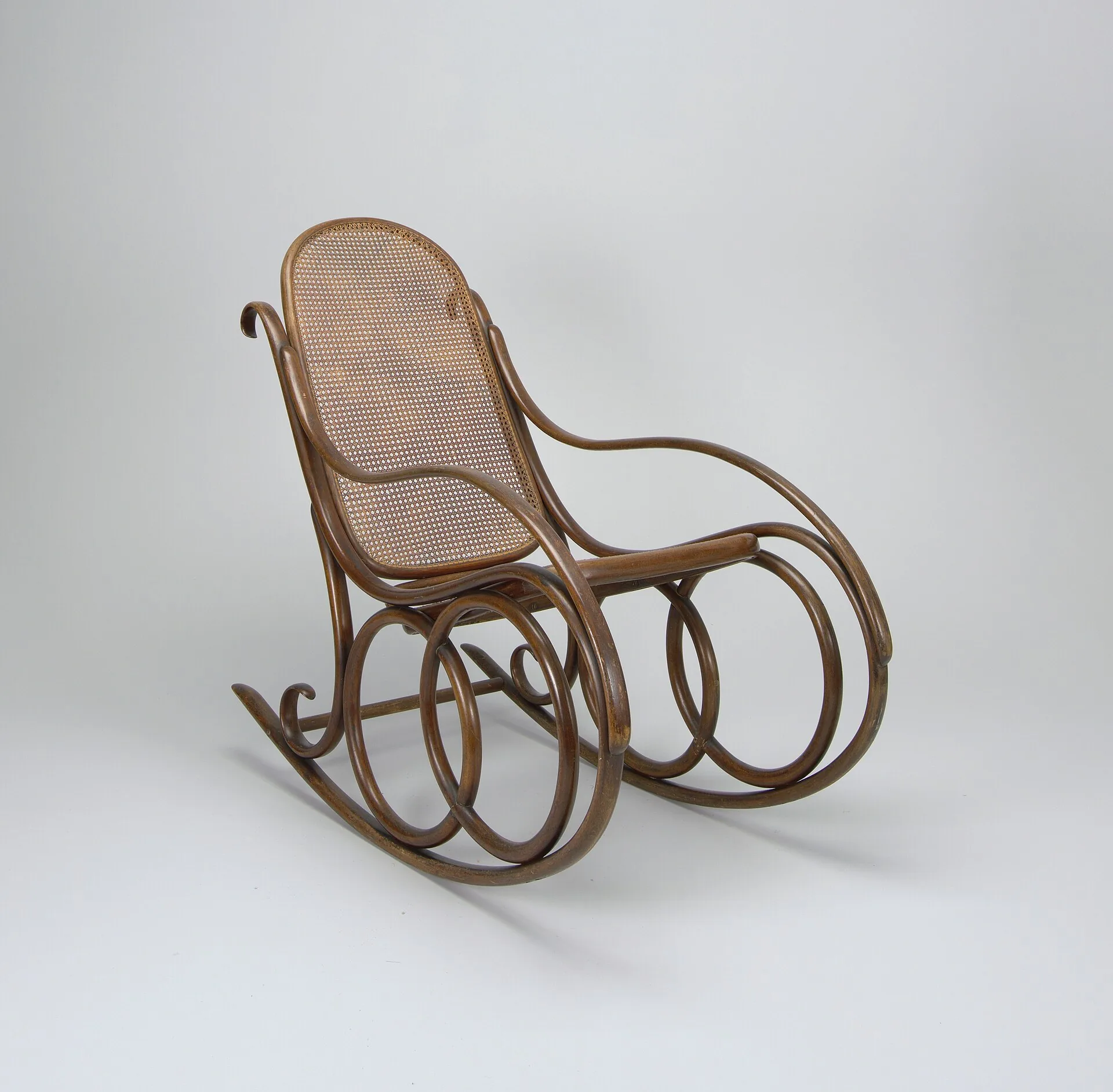
Bending wood was not new. The rocking chair above was made around 1860, seventy years before Paimio, and every curve in it is beech bent with steam. What Aalto and his manufacturer added was lamination and glue: thin layers pressed into a form, which holds a shape steam alone cannot, and which is stiff enough to be structural.
The famous result is not a chair at all. It is the L-leg of 1933, used on Stool 60. A solid birch leg is sawn into thin kerfs at one end, glue and veneer slips are driven into the cuts, and the sawn end is bent through ninety degrees and clamped. What comes out is a leg that turns into the underside of a seat with no bracket, no apron and no joint to fail.
He patented it. Stool 60 has been in production since 1933 and is still made.
Three. The two names that are usually missing.
The bending was worked out with Otto Korhonen, who ran a furniture factory in Turku, over years of experiments. Aalto did not develop those techniques alone at a drawing board, and Korhonen's name deserves to be in the sentence.
The other name is Aino Marsio, who was an architect, who married Aalto in 1924, and who worked as his full collaborator until her death in 1949. In 1935 the two of them founded Artek with Maire Gullichsen and Nils-Gustav Hahl, specifically to sell and promote the furniture. Aino ran it as its design director.
This series has now hit that pattern twice in three episodes. Juhl needed Vodder. Aalto needed Korhonen and Aino Marsio. The single-genius version of these stories is a marketing convenience.
Aalto died in 1976.
What to carry forward
Write the brief about a person, not a room. Ask what the body is doing in the piece, for how long, and in what state. The answers change dimensions.
Choose the material against the fashion if the fashion is wrong for the user. Steel was the modern answer in 1932. It was still the wrong thing to put next to a tuberculosis patient.
The joint is the invention. Aalto's most copied idea is not a chair, it is a way of turning a corner in solid wood. Look for problems at that scale, because that is where the durable ideas are.
Say the other names. Korhonen and Aino Marsio were not assistants. Getting the credit right costs nothing and it is a fair account of how things actually get built.
A note on sources
His birth in 1898 in Kuortane and death in 1976, the Paimio Sanatorium competition of 1929 and its completion in 1933, the Paimio Chair of 1932, the L-leg and Stool 60 of 1933, the collaboration with the furniture manufacturer Otto Korhonen in Turku, his marriage to the architect Aino Marsio in 1924 and the founding of Artek in 1935 with Maire Gullichsen and Nils-Gustav Hahl are documented by the Alvar Aalto Foundation, by Artek, and by the standard architectural literature.
The intent behind the Paimio Chair's back angle, easing the sitter's breathing, is the account given by the Aalto Foundation and by Artek, who still make it.
His estate is live and the designs are still in production, so none of his work is reproduced here. The rocking chair above is anonymous, made around 1860 in the Austrian bentwood trade, and it is here because it proves the technique he is credited with was already seventy years old. What he changed was how it was done and what it was for. We will come to Michael Thonet, who built that trade, later in the series.